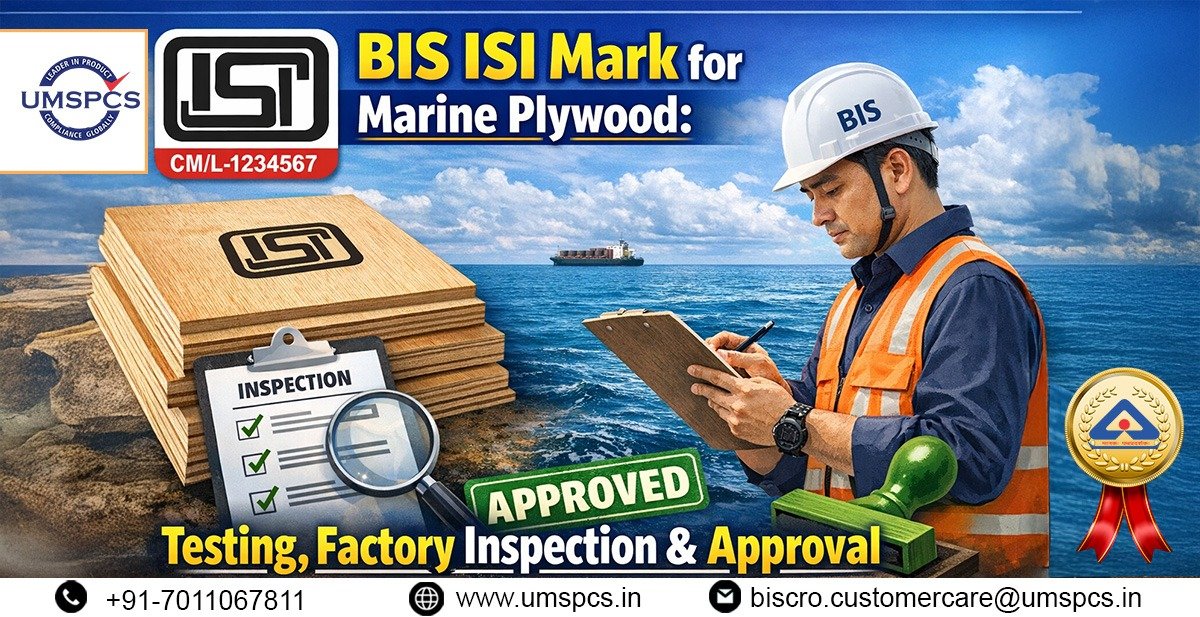
Construction of ships, coastal projects, furniture for outdoor use, bathrooms, kitchens, and other marine related uses are only a few examples of the difficulty, wet conditions that marine plywood is made to survive. The Indian government demands for the necessary standards required for quality and safety which considers plywood’s key function and the chances of producing poor plywood; that’s when the BIS Certification enters to make it highly desirable.
In this blog, we’ll look out to get acknowledge about what BIS Certification for marine plywood is , what makes it important, how everything works, and how can UMSPCS help in your BIS Certification and make the process simple for manufacturers and companies.
What Is BIS Certification?
The Bureau of Indian Standards (BIS) is India’s national standards body that gives the ISI mark used for quality certification. It verifies its compliance with the essential Indian Standards (IS) and provides security and quality in India. The product’s status of compliance with Indian performance, safety, and technical standards will only be verified through BIS certification.
For plenty of products — including marine plywood — BIS certification is legally required under the BIS Act and Quality Control Orders given out by the Ministry of Commerce and Industry. Manufacturers and importers have no way to sell their goods without this certification.
Marine Plywood & IS 710 Standard
Marine plywood is different from other plywood because it is especially made for resistance to continuous exposure of water, fungal damage, and structural decay. The correct Indian Standard for marine plywood is as follows:
IS 710:2010 – Marine Plywood
In order give a secure marine plywood that is water-resistant and long lasting for heavy work use, this standard states out rules for its manufacture, materials, dimensions, sealing qualities, and mechanical and physical factors.
The plywood has to go through required physical inspections under IS 710:
- Testing if it is waterproof and connection of glue is correct or not.
- Inspections of moisture and strength when it bents
- Dimensional accuracy is also necessary
- Prohibiting the growth and decay of wood
The reason for this makes secure and safe plywood for marine use which functions consistently whether the environment is damp or wet.
Why BIS Certification for Marine Plywood Matters
1. Legal Requirement
In every aspect wood products distributed domestically in India needs to possess BIS certification given that marine plywood has to conform to the Quality Control Order.
Products which do not have a valid certification may be seized in the market, inspected at ports, or taken off the market, which could lead to fines, penalties, and a lack of market access.
2. Quality Assurance
Customers and builders have assurance that marine-specific plywood conforms to specified quality, safety, and performance standards because of to the BIS ISI Mark and BIS certification. This can be especially important in construction, marine applications, and infrastructure projects where inferior supplies can cause damage to the structure and financial loss.
3. Market Status and Competitive Benefit
BIS-certified products come with the ISI mark that is familiar to Indian consumers and businesses. This mark shows the reputation of the brand, Improve client trust, and gives possibilities for government tenders, export markets, and large contracts for purchase which can benefit your business in various ways.
4. Protection Against Substandard Products
Highly rigorous certification standards make certain that unsafe plywood with poor binding agents or insufficient bonding — frequently seen in less expensive imported or local unapproved products — continues to stay out of the market, improving overall industry quality.
BIS Certification Process for Marine Plywood
The process for being certified in BIS is tightly controlled and structured. For proper adherence to IS 710, manufacturers have to take specific measures.
Step 1: Find the Required Standard
Manufacturers have to keep an eye on all test requirements and should confirm that they meet the required Indian Standards (IS) 710.
Step 2: Product Testing
Marine Plywood samples undergo examination in labs approved by BIS to assess the following:
- Absorption of shock
- Resistance to expansion
- Guarding for electricity
- Strength of the chin strap
For certification to be accepted, testing must be successful.
Step 3: Application Submission
The manufacturer uploads an application with BIS and includes:
- Descriptions of products and diagrams
- Test outcomes
- Documents concerning manufacturing processes
- Instructions for quality control
Step 4: Factory Inspection
BIS inspects factories to confirm the following:
- Manufacturing capacity
- Systems for managing quality
- In-house testing facilities
- Batch control and identification
Step 5: Grant of BIS License
The manufacturer receives a license to use the BIS ISI Mark on Marine Plywood only if the product and factory meet the BIS requirements.
Step 6: Monitoring and Renewal
Certification in BIS is removable. To guarantee ongoing compliance, sample testing and surveillance inspections take place regularly. After some time, licenses need to be renewed.
Difficulties that Manufacturers Face
Understanding whether their products fall under mandated categories
- Deciding which BIS scheme applies
- Coordinating testing and factory audit schedules
- Preparing accurate technical documentation
- Navigating follow-up communications with BIS
These challenges are magnified for foreign manufacturers who may have little experience with Indian regulatory frameworks.
How UMS Product Compliance Services Helps You
If your business is navigating product compliance in India, UMS Product Compliance Services (UMSPCS) – Trusted BIS Registration Consultants in India offers expert support from start to finish. UMSPCS is a full-service regulatory consultancy that specialises in helping manufacturers and brands get BIS Certification—and other regulatory approvals—without stress or delays.
What UMSPCS Offers
UMSPCS simplifies the entire BIS certification journey by handling everything—from product evaluation to license grant.
UMSPCS Services Include:
- BIS testing coordination with the approved labs
- Complete documentation preparation
- BIS portal filing and application management
- Factory inspection preparation & support
- Query handling and follow-ups with BIS
- License grant assistance
- Renewal, amendment & surveillance support
UMSPCS works with Indian manufacturers, importers, and foreign manufacturers, ensuring faster approvals and zero compliance risks.
In conclusion
BIS certification is not just for the legal requirement but its for the safety and security for the consumers who are aiming to buy it. BIS Certfication for marine plywood under IS 710 that confirms to the quality, safety, and market credibility. Through difficult demands in accordance with in depth testing of protocols, dealing with this complex process on your own can be challenging for you. That’s where skilled supporters like UMSPCS step in to make your compliance journey simple and stress-free.
Marine plywood products combined with the most demanded requirements does not just conform with laws but also gain trust among the customers, builders, and brand owners across the world — setting a complete way for the growth in one of India’s greatest market of construction material.
Frequently Asked Questions (FAQs)
Q1. What occurs if the Marine Plywood get into the Indian Market without BIS certification?
A- Failure to comply could give rise
- Seizure of a product
- Rejection of imports at borders
- High cost penalties
- Legal action
- Cancellation or suspension of a license
Compliance is a requirement for law and not optional.
Q2. Does factory inspection is necessary for gaining BIS certification?
A- Yes, factory inspection must get done by the BIS officials. Throughout the inspection of factories, BIS confirms these as mentioned below:
- Capacity for production of products
- In-house testing facilities are provided
- Systems for quality control to secure the quality of products
- Get inline with the IS 710:2010 standards for product necessity
Q3. Who actually among the marine plywood production calls for BIS certification to hit the Indian market?
A- BIS certification needs to be obtained:
- Manufacturers from other countries that sell to India
- Brand owners and importers
- Foreign manufacturers who’re selling marine plywood in India
Q4. What kind of tests are performed by the Marine plywood producers to obtain the BIS certifications?
A- Testing for waterproofing and better glue connections mentioned as follows:
- Inspections of moisture and strength when it get bents
- Dimensional accuracy
- Prohibiting the growth and decay of wood
Q5. How can BIS certification be aided by UMS Product Compliance Services (UMSPCS)?
A– End-to-end BIS certification assistance is provided by UMS Product Compliance Services (UMSPCS), which includes:
- Finding the relevant IS standards
- Planning for product compliance
- Coordination with BIS-approved labs
- Documentation and submission of applications
- Help with factory inspections
- After certification support
We have a team of experts and professionals in this field who made this complex compliance journey into simpler and smoother way.
❓ Ask a Question
Have any doubts? Fill the form below and our team will respond shortly.