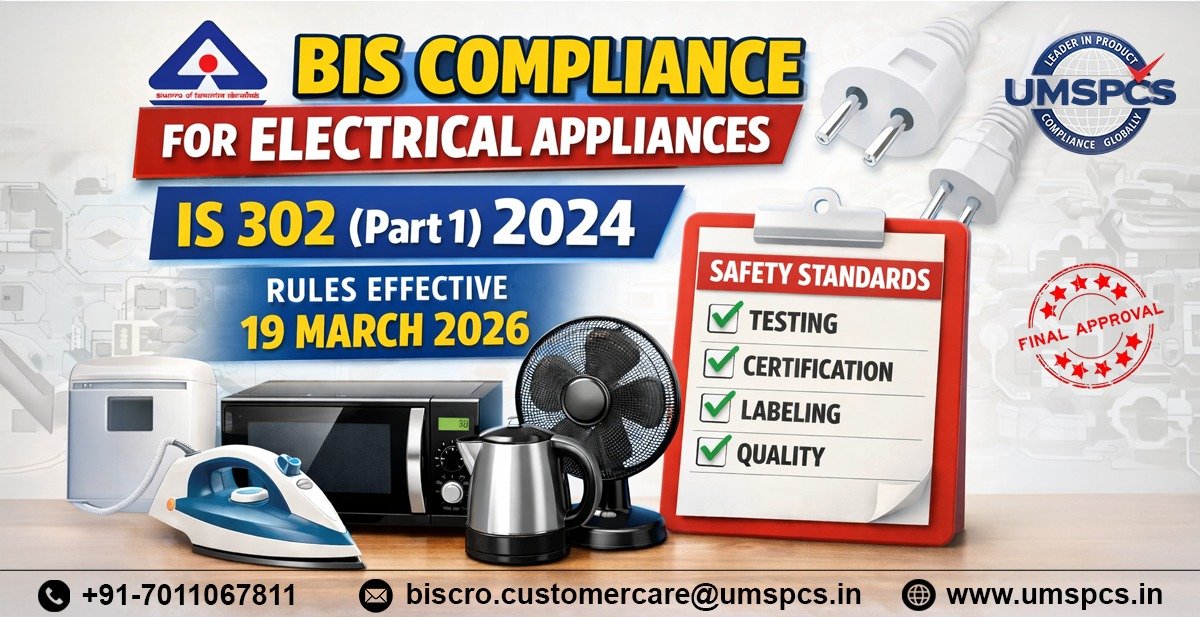
Indian manufacturers of electrical products are required to get themselves prepared to deal with an important alteration in rules and regulations. On March 19, 2026, the Bureau of Indian Standards (BIS) is going to implement the newly revised IS 302 (part 1): 2024 standard. With this version of the update, electrical appliance safety security standards have been improved, and compliance has become more uniform and practically in accordance with the international standards to get the BIS compliance for electrical appliances.
Understanding these updated laws will be essential in preserving your market access for those who manufacture, purchase, or distribute electrical products in the nation of India.
What is BIS Compliance and Why Does It Matter for Electrical Appliances
Bringing together the safety and quality standards established by the Bureau of Indian Standards is commonly referred to as being BIS compliant. IS 302 (part-1) describes essential safety requirements for electrical appliances, which include the following:
- Security regarding electric shock.
- Resistance to heat & fire resistance.
- Power of mechanics.
- Required for insulation.
- Secure wiring and correct earthing.
This regulation might be applicable to one of these kinds of electrical appliances, as follows:
- Irons that operate on electricity.
- Heaters for rooms.
- Geysers.
- Appliances for the kitchen.
- Fans, along with home appliances.
The security of products and legal clearance for distribution in India are assured by the BIS certification. Fines, product recall, or bans on market entry can give rise to potential consequences for failure to comply.
Key Changes in IS 302 (Part 1) 2024
Many of the administrative and technical modifications are included in the new IS 302 (part-1): 2024. These alterations are meant for greater safety for consumers while also bringing Indian Standards in accordance with the global norms.
The majority of primary features are as follows:
Updated security testing guidelines
A bit stricter testing for a rise in temperature, current loss, and resistance of insulation.
Revised fire safety standards
More extensive examination of components exposed to high temperature.
Superior standards for identification and labelling
Boosted the availability of data, warning signs, and details about the product.
Acceptance of IEC standards
Higher conformity with global security standards to help with global trade.
Enhanced factory system for monitoring
The testing of samples and periodic reviews are needed for assuring continuous compliance.
Upcoming Mandatory BIS Standards and Enforcement Dates (2026)
| Sr. No. | Ministry / Department | Product | Indian Standard | Enforcement Date |
| 1 | Department for Promotion of Industry and Internal Trade | An important step toward higher electrical safety standards in India will be taken with the implementation of IS 302 (Part 1): 2024 on March 19, 2026. To comply with the updated BIS regulations, producers, importers, and distributors need to proactively update their goods and compliance systems. All electrical appliances intended for household,commercial or similar applications with rated voltage not exceeding 250 V for single-phase appliances and 480 V for other appliances including direct current supplied appliances and battery operated appliances. A seamless and risk-free transition can be achieved with early planning, appropriate documentation, and professional advice. Businesses can effectively obtain BIS certification and guarantee continuous access to the Indian market with the help of knowledgeable compliance partners like UMSPCS. | IS 302 (Part 1): 2024 / IEC 60335-1:2020 | 19 March 2026 |
| 2 | Ministry of Electronics and Information Technology | Audio/Video, Information and Communication Technology Equipment – Part 1 Safety Requirements | IS/IEC 62368 (Part 1): 2023 | 1 May 2026 |
| 3 | Ministry of Electronics and Information Technology | Digital Television Receiver for Satellite Broadcast Transmission | IS 18112:2022 | 26 July 2026 |
| 4 | Ministry of Textile | Cotton Bales | IS 12171:2019 | 27 August 2026 |
| 5 | Department for Promotion of Industry and Internal Trade | Pipe Wrenches – General Purpose | IS 4003 (Part 1):1978 | 01 October 2026 |
| 6 | Department for Promotion of Industry and Internal Trade | Pipe Wrenches – Heavy Duty | IS 4003 (Part 2):1986 | 01 October 2026 |
| 7 | Department for Promotion of Industry and Internal Trade | Open-Jaw Wrenches (Spanners) | IS 2028:2004 | 01 October 2026 |
| 8 | Department for Promotion of Industry and Internal Trade | Ring Wrenches (Spanners) | IS 2029:1998 | 01 October 2026 |
| 9 | Department for Promotion of Industry and Internal Trade | Single-ended Open-Jaw Adjustable Wrenches | IS 6149:1984 | 01 October 2026 |
| 10 | Department for Promotion of Industry and Internal Trade | Chain Pipe Wrenches | IS 4123:1982 | 01 October 2026 |
| 11 | Department for Promotion of Industry and Internal Trade | Open-Ended Slugging Wrenches (Spanners) | IS 4508:1992 | 01 October 2026 |
| 12 | Department for Promotion of Industry and Internal Trade | Ring Slugging Wrenches (Spanners) | IS 4509:1992 | 01 October 2026 |
| 13 | Department for Promotion of Industry and Internal Trade | Combination Side Cutting Pliers | IS 3650:1981 | 01 October 2026 |
| 14 | Department for Promotion of Industry and Internal Trade | Wrought Aluminium Utensils | IS 1660:2024 | 01 October 2026 |
| 15 | Department of Chemicals and Petrochemicals | Aluminium Cans for Beverages | IS 14407:2023 | 01 October 2026 |
| 16 | Department of Chemicals and Petrochemicals | HDPE/PP Woven Sacks for Packaging of 50 kg Cement | IS 11652:2017 | 06 October 2026 |
| 17 | Department of Chemicals and Petrochemicals | PP/HDPE Laminated Woven Sacks for Mail Sorting, Storage, Transport & Distribution | IS 17399:2020 | 06 October 2026 |
| 18 | Department of Chemicals and Petrochemicals | PP Woven, Laminated, Block Bottom Valve Sacks for Packaging of 50 kg Cement | IS 16709:2017 | 06 October 2026 |
Enforcement Timeline – 19 March 2026
The freshly upgraded IS 302 (part-1): 2024 standards are mandated by the law from March 19, 2026.
Things that are necessary to remember:
- After this date, manufactured products have to stick towards the newly upgraded standard.
- According to the revised version, existing license owners could have the opportunity to submit an application for renewal or alterations.
- Testing should be performed in laboratories approved by BIS only.
Supply chains might be interrupted, and legal difficulties could come up if compliance is neglected. It is strongly suggested to get ready ahead of time.
How Manufacturers Can Achieve BIS Certification
Manufacturers need to get on the correct scheme if they want to purchase electrical appliances legally across the nation.
Step-by-Step BIS Certification Production
Even though all products might use variations in BIS certification for electrical appliances, the following steps usually take place in the basic process:
1. Product Testing
Send your samples of products to a lab approved by the BIS to ensure that they are able to be verified with the correct Indian Standard.
- Inspection and Paperwork
Create material specifications, procedures, and technical documentation. To prove your compliance, submit samples of the product to a testing facility approved by BIS.
- The Submission of an Application
Using the BIS online portal, upload your application together with the necessary paperwork and test results.
- Inspection of the Factory
For the purpose of verifying that manufacturing procedures and quality control systems correspond to standards, BIS may carry out live inspections.
5. The acceptance & Packaging
The manufacturer receives a license to use the ISI mark only if the product and factory meet the BIS requirements.
6. Check in and Renewal of previous certification
Certification in BIS is removable. To promise ongoing compliance, sample testing and surveillance inspection should take place constantly. After some time, licenses are meant to get renewed.
Tips to Get Successful in Compliance
- Test the product inside out before offering it.
- Keep your technical documentation correct and up to date.
- Maintain the purity of raw materials.
- Introduce the updated revised 2024 standards related to the quality control workforce.
- Fill the application carefully before the March 2026 deadline.
Seeking help from professional consultants to make it simpler by managing the application, testing, scheduling, and documentation.
UMSPCS offers complete support and professional guidance for regulatory compliance, registration of the ISI mark, and BIS certification for electrical appliances. They have a workforce that makes compliance smooth with IS 302 (part-1):2024 by assisting manufacturers with documentation, test scheduling, and factory audit.
In conclusion
A significant move to establish improved safety standards in India is going to be accomplished using the official launch of IS 302 (part-1): 2024 on March 19, 2026. To get inline with the freshly revised BIS regulation, which states that the manufacturers, traders, and distributors who’re aiming to renew their products and compliance layout.
A smooth and secure shift is achievable with proper strategy, appropriate paperwork, and expert guidance. Businesses are capable of getting BIS certification and ensuring ongoing access towards the Indian market, along with the assistance of experienced compliance partners like UMSPCS.
Read more about also: BIS Certificate of Conformity
Frequently Asked Questions:
- Q. What is the IS 302 (part-1): 2024?
A- The Bureau of Indian Standards holds the responsibility for the newly revised Indian safety standard IS 302(part-1):2024 for household and relevant electrical appliances. It offers safety requirements to avoid electric shock, fire dangers, and risk from mechanics.
- Q. From when has the new IS 302 (part-1): 2024 become compulsory?
A- The newly upgraded standard will be enforced by March 19, 2026. Manufactured products after this date must align with the upgraded demands.
- Q. Is BIS certification compulsory for every electrical appliance?
A- Several of the electrical appliances are compulsory for certification schemes. Manufacturers should check whether the specified product type needs the mandated BIS certification, in line by the government notification.
- Q. What is the ISI mark and its importance?
A- The ISI marks show if the product meets every necessary BIS standard. It promises consumers that the electrical appliance follows the safety and quality standards.