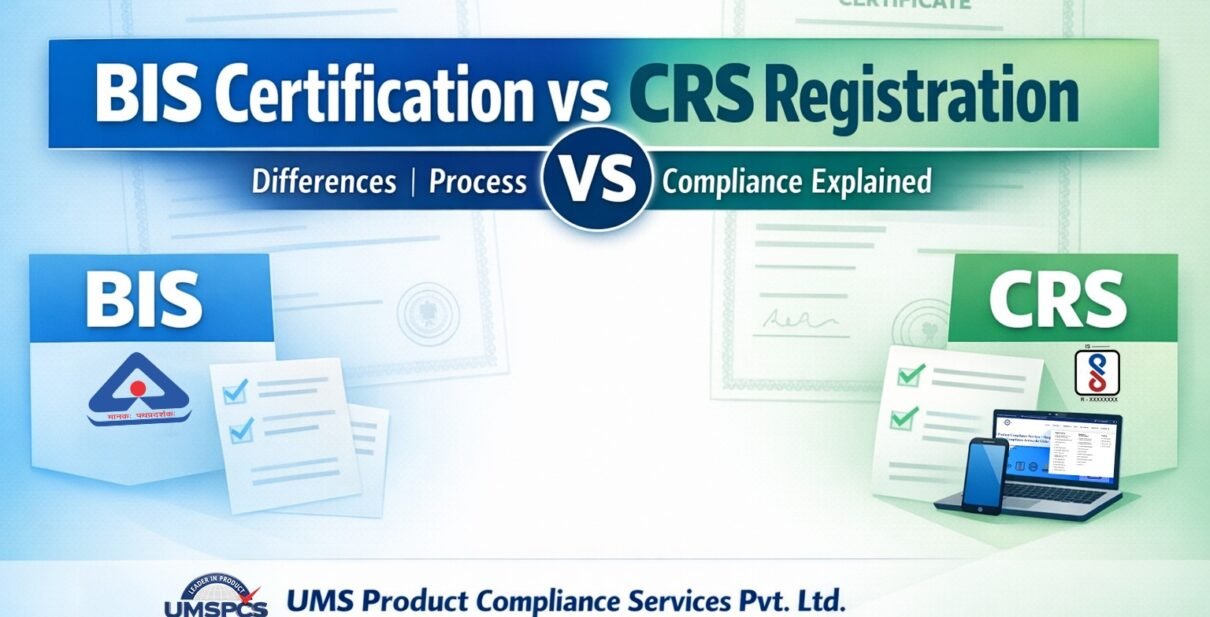
In today’s competitive environment, maintaining product quality, security, and regulatory conformity has become a business survival instinct and not just a legal necessity. BIS Certification and CRS registration tend to be two primary regulatory structures that regulate this field in India. While both of them look for consumer safety and follow the quality standards, how they work, their relevance to different categories of products, and separate procedures.
In order to assist manufacturers, importers, and traders in making informed choices, we will look into the primary layers, defined procedures, and the requirement for compliance among BIS & CRS in this blog.
What is the BIS Certification?
The Bureau of Indian Standards holds the responsibility of building standards for product quality, releasing Indian standards (IS), and managing compliance based certification schemes. The products you sell comply with Indian security, reliability, and overall quality if it has given the BIS certification.
BIS Certification must be maintained because of the following purposes:
- Promises product safety & reliability
- Improvements in trust among consumers and the brand image.
- acceptable for international as well as domestic markets in India
- assists in avoiding penalties, bans, or limitations on markets over failure to comply
Where BIS certification is required
Products covered by the BIS certificate consist of:
- Electronic and electrical products (like cables and switches)
- Applications for residence
- Product composed of steel
- Cement building materials
- Medical devices
- Food items that come together to meet AGMARK/ISI standards.
What is CRS Registration?
The Indian Department of Electronics Standardisation & Quality (DESQ) implemented the CRS (Compulsory Registration Scheme) for a regulatory framework that monitors the quality of electronics goods carried into and sold in India.
It indicates that electronic products correspond with Indian safety and technical standards prior to being released on the market and requires manufacturers, importers, and sellers to undergo required registration.
Important Items Discussed
Certain IT and electronic products are addressed by CRS, including:
- Cell phones
- Chargers and data cables
- Tablets and laptops
- CCTV
- Headphones
- Smart watches
- Bluetooth gadgets
In response to market demands and safety concerns, the listing of products covered by CRS is updated on an ongoing schedule.
BIS Certification vs. CRS Registration: Key Differences
| Feature | BIS Certification | CRS Registration |
| Regulatory Authority | Bureau of Indian Standards | Department of Electronics Standardisation & Quality (DESQ) |
| Type of Regulation | Standard quality certification | Compulsory registration scheme for electronic products |
| Applicable Products | Wide range across sectors | Electronics & IT products |
| Legal Requirement | Mandatory for specified products | Mandatory for products listed under CRS |
| Testing Requirements | Product testing at BIS-recognised labs | Testing at BIS/DESQ-accredited labs |
| Marking | ISI mark / standard mark | CRS Registration Number (CRS-ID) |
| Validity | Generally 1 year (renewable) | Generally 1 year (renewable) |
| Imported Products | Yes (if sale/marketing in India) | Yes (specific electronics) |
Process to Get CRS Registration
1. Check Product Applicability
Take the DESQ website to find out if the item you want is included in the CRS order.
2. Testing at Accredited Labs
Give yourself the product verified for the appropriate standards at a lab approved by BIS/DESQ.
3. Create DESQ Account
Complete the product details and register through the DESQ online portal.
4. Submitted Paperwork
In general, documents are composed of the following:
- Test outcomes
- The complete paperwork for the product
- Information on marketing
- PAN while dealing with evidence from the manufacturer or importer
- Requires PAN of the manufacturer or importer for identity evidence.
5. Reviewing the application
It might be possible for the authority to demand more tests and assessments after the submission of application.
6. Distribution of CRS Certificate
CRS registration number or CRS ID should be displayed on the products and their packaging for selling your products after receiving a CRS certificate.
7. Yearly Renewal
To stay compliant one needs to update their certification every year.
Process to Get BIS Certification
BIS Certification might seem complex because of the procedures, but it can be organised and simple with the right plan and focus.
1. Find Out the Correct Standards
Find out the correct Indian Standards and check to what extent your products will meet the requirements of QCO before starting the certification process. We can prevent postponements and conclusions by this process.
2. Conduct Product Testing in BIS-Recognised Labs
Your substance has to undergo examination in an Indian laboratory that has been officially authorised by the BIS. Among the most important components of your application acceptance is the evaluation outcome that is generated.
3. Prepare Documentation
Plenty of documents must be submitted for BIS certification. Common requirements involve the following :
- Complete product specs and drawings
- Procedures for quality control
- Information about the factory and manufacturing
- Test reports from recognised labs
- Certificates of trademark (when needed)
Approval times are immensely decreased when both of these are put together prior to submitting them.
4. Submit Your Application to BIS
The BIS portal has been utilized for submitting applications through the internet. Your test outcomes, supporting documentation, and any required fees are going to be handed in by you or the person representing you. BIS initiates the assessment and confirmation procedure right away as the application arrives at it.
5. Factory Audit by BIS Officials (If Applicable)
BIS might carry out live factory audits for ISI mark certifications with the aim to make certain that production checks and manufacturing procedures conform to Indian standards. During this inspection, facilities need to have quality guidelines and documentation prepared.
6. Check in and Renewal of previous certification
The BIS License is in charge of the Bureau of Indian Standards after getting the certification through the inspection, verification, and process instruction. After the approval is granted, they are allowed to show the ISI mark on their products and their packaging, which will serve as an important symbol for Indian consumers.
7. Renewal and After Certification Services
Receiving BIS Certification through an uingoing inspections. When the standards get modified, it is your role to keep the compliance by regular audits, renewals, and notification of updates by getting BIS certification. You can benefit by avoiding a good reputation by preventing it from fines and ensuring continuous compliance.
Compliance Challenges & Best Practices
It might be difficult to understand BIS and CRS regulations, specifically for freshly established importers or manufacturers.
Usually difficulties faced by them are as follows:
- Recognising the applicability of product categories
- Failures in testing because of queues in the lab
- Mistakes in document submission
- Compliance with renewal and monitoring
To prevent expensive rejections or fines for noncompliance:
- Seek out regulatory consultants as soon as possible.
- Keep all of your technical documentation accurate and up to date.
- Schedule inspections and testing effectively in ahead of time.
- Keep a watchful eye on alterations to product category listings and standards.
How UMSPCS Can Help in Your BIS Journey
UMS Product Compliance Service (UMSPCS)– Trusted BIS Compliance Consultant, which offers complete guidance by experts from the initial stage to final approval. UMSPCS is a complete regulatory consultancy that assists manufacturers and brands to receive BIS certification as well as other required regulatory approvals by avoiding delays and stress.
What UMSPCS Offers
UMSPCS simplifies the whole BIS Certification journey by providing complete guidance from product evaluation to the license permit.
UMSPCS Services Include:
- Testing of products in BIS approved labs only.
- Preparing complete paperwork
- Submission of application online through the BIS portal
- Preparing for factory audits
- Coordinating with BIS and handling the query
- Support in the approval of license
- Support in renewal, amendment, and monitoring
UMSPCS works with Indian manufacturers, importers, and foreign manufacturers, ensuring faster approvals and zero compliance risks.
In Conclusion
In India, BIS Certification and CRS Registration both of them are essential for maintaining consumer safety, product quality, and regulatory compliance. Businesses ar able to avoid legal consequences and gain the trust of their clients through staying aware of the distinctions, deadlines, and necessities.
Make certain that you select the appropriate compliance procedure ahead of launching or importing goods into India. For ultimate accuracy while speeding out the process, take into account expert assistance like UMSPCS.
Frequently Asked Questions (FAQs)
- Q. What is the BIS Certification?
A- The Bureau of Indian Standards holds the responsibility of building standards for product quality, releasing Indian standards (IS), and managing compliance based certification schemes. The products you sell comply with Indian security, reliability, and overall quality if it has given the BIS certification.
- Q. What is the CRS Registration?
A- The Indian Department of Electronics Standardisation & Quality (DESQ) implemented the CRS (Compulsory Registration Scheme) for a regulatory framework that monitors the quality of electronics goods carried into and sold in India.
- Q. Is BIS Certification compulsory in India?
A- Yes. BIS Certification is compulsory only for specific products that include electrical appliances. Steel products, toys, and cement. Marketing of these products without having the BIS certification can give rise to fines, seizure of the product, and legal suits.
- Q. Is CRS Registration compulsory for imported electronics?
A- Yes. CRS Registration is compulsory for imported electronics, which include IT products, no matter whether they are manufactured in India or imported. Products who dont have CRS registration can not sell their products into the Indian market.
- Q. Can a consultant support the BIS certification?
A- Yes. Professional consultants like UMSPCS, who provide complete support with documentation, lab testing, application submission, and a complete BIS approval process to ensure a smooth and quick compliance process for you.