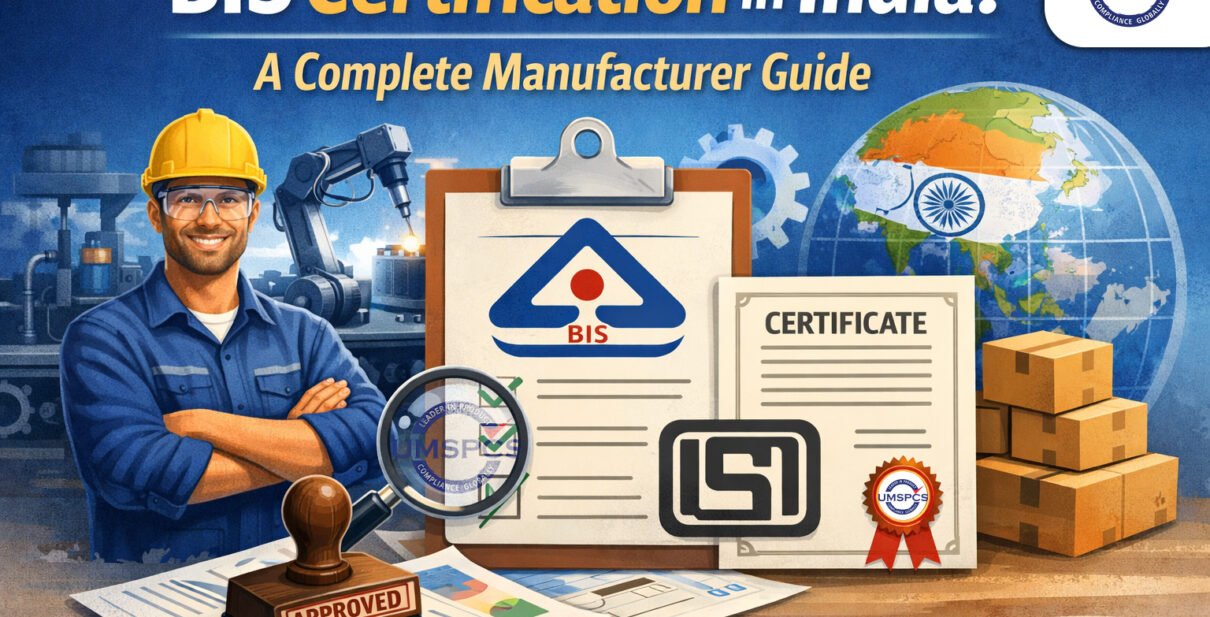
In India, there is a strong demand for goods like Bluetooth devices, Wi-Fi routers, smartwatches, and Internet of Things products. Before being sold, all wireless products must, however, adhere to BIS regulations. Product safety, quality, and lawful market access in India are guaranteed by mandatory BIS Certification under CRS, ISI Certification, or FMCS for international manufacturers.In this blog, we addressed everything about the BIS Certification in India including the application, procedures, documentation, and methods through experienced professionals like UMS Product Compliance Services (UMSPCS) who can help in accelerating your compliance process.
What Is BIS Registration?
India’s National Standards body which is the Bureau of Indian Standards (BIS), which holds the control of establishing standards and verifying if the product confirms with the certification mark like the ISI mark. BIS certification in India is necessary, which states that the product fulfiulls certain Indian Standards and went through tests and inspection with the BIS officials.
Before hitting to the Indian market, manufacturers are bound by this system to make assured that their products conform with the relevant Indian Standard (IS).After confirmation, the product has to display the BIS Standard Mark and receive a number for registration (R-number) by BIS.
Why BIS Registration Is Mandatory in India
Compliance has become essential considering wireless products use electronic circuits and radio frequencies in order to work. For the following reasons, BIS registration is required:
1. Legal Requirement
According to CRS Registration, the Indian government provides notices for products without the BIS Certification which in result give rise to penalties, product seizing, import denial, or market bans might occur for the distribution of unapproved products.
2. Consumer Safety
BIS testing are actually secure to use while being free from dangers and other issues to use safely by the consumers.
- Market Credibility
Digital sellers, distributors, and customers are all confident in products that have been verified with the BIS. Before displaying products, many of online retailers need BIS approval.
4. Smooth Import & Distribution
Deliveries with no valid BIS registration could get seized by customs officers, causing disruptions and financial loss.
Step-by-Step: Process of BIS Certification in India
Even though all products might use variations in BIS certification processes, the following steps usually take place in the basic process:
1. Product Testing
Send your samples of products to a lab approved by the BIS to ensure that they are able to verified with the correct Indian Standard.
- Inspection and Paperwork
Create material specifications, procedures, and technical documentation. To prove your compliance, submit samples of the product to a testing facility approved by BIS.
- The Submission of an Application
Using the BIS online portal, upload your application together with the necessary paperwork and test results.
- Inspection of the Factory
For the purpose to verify that manufacturing procedures and quality control systems correspond to standards, BIS may carry out live inspections.
5. The acceptance & Packaging
The manufacturer receives a license to use the ISI Mark only if the product and factory meet the BIS requirements.
6. Check in and Renewal of previous certification
Certification in BIS is removable. To promise ongoing compliance, sample testing and surveillance inspection should take place constantly. After some time, licenses are meant to get renewed.
Performing this step can be challenging, particularly among foreign producers or those who were getting into the Indian market for the first time.
Key Documents Required for BIS Registration
Usually, the documentation needed for BIS registration includes:
- Test results from a lab with BIS verification
- Technical information and specifications for products
- Details of the factory and manufacturer
- Confirmation of acceptance
- Details of the label and marking
- Letter of approval
Details of the Authorized Indian Representative (AIR) for foreign producers
The most frequent causes of mistakes or rejections are missing or inaccurate documentation.
How Professional Help Makes a Difference: UMSPCS
If your business is getting tracked by product compliance in India, UMS Product Compliance Services (UMSPCS) – Trusted BIS Certification Consultants in India gives expert support from start to finish. UMSPCS is a full-service regulatory consultancy that helps in manufacturers and brands get BIS Certification in India—and other regulatory approvals—without stress or delays.
What UMSPCS Offers
UMSPCS simplifies the whole BIS Certification journey by complete guidance from product evaluation to license permit.
UMSPCS Services Include:
- BIS testing coordination with the approved labs
- Complete documentation preparation
- BIS portal filing and application management
- Factory inspection preparation & support
- Query handling and follow-ups with BIS
- License grant assistance
- Renewal, amendment & surveillance support
UMSPCS works with Indian manufacturers, importers, and foreign manufacturers, ensuring faster approvals and zero compliance risks.
Difficulties that Manufacturers Face
Understanding whether their products fall under mandated categories
- Deciding which BIS scheme applies
- Coordinating testing and factory audit schedules
- Preparing accurate technical documentation
- Navigating follow-up communications with BIS
These challenges are magnified for foreign manufacturers who may have little experience with Indian regulatory frameworks.
In Conclusion
In India, manufacturers and importers of wireless products are forced by law to file paperwork with the BIS; it has become a compulsory procedure. BIS certification in India is crucial for the profitability of wireless products, from maintaining consumer safety to achieving access to markets and credibility.
Businesses may prevent compliance challenges and stay focused on their growth by hiring experienced professionals like UMSPCS, whose work is to handle the complete regulatory process.
Carrying out your BIS registration process in advance and receiving the right advice could result in every difference if you plan on selling wireless products in India.
Frequently Asked Questions (FAQs)
Q. During BIS Certification, what are the difficulties that manufacturers have to face?
A- Manufacturers commonly faces difficulties such as follows:
- Identifying the correct BIS standard
- Managing lab testing and inspections
- Preparing accurate technical documentation
- Handling BIS queries
UMSPCS handles these challenges end-to-end.
- Q. What’s the timeline one needs to receive the BIS Certification of their product?
A- On average, the timeline is anywhere from three to six months, primarily based on the following:
- Product category
- Testing timelines
- Factory inspection readiness
- BIS query resolution
With expert consultants like UMSPCS, delays can be minimised.
- Q. Why should I choose UMS Product Compliance Services?
A- UMSPCS is one of the trusted BIS certification consultants in India, offering:
- End-to-end BIS certification support
- Faster approvals
- Zero compliance risk
- Dedicated handling for Indian & foreign manufacturers
Q. What in real happen when the BIS surveillance inspection happens?
A- BIS conducts surveillance inspections to ensure continued compliance. This may include:
- Factory visits
- Sample testing
- Documentation review
UMSPCS supports manufacturers during surveillance to avoid suspension or cancellation
❓ Ask a Question
Have any doubts? Fill the form below and our team will respond shortly.