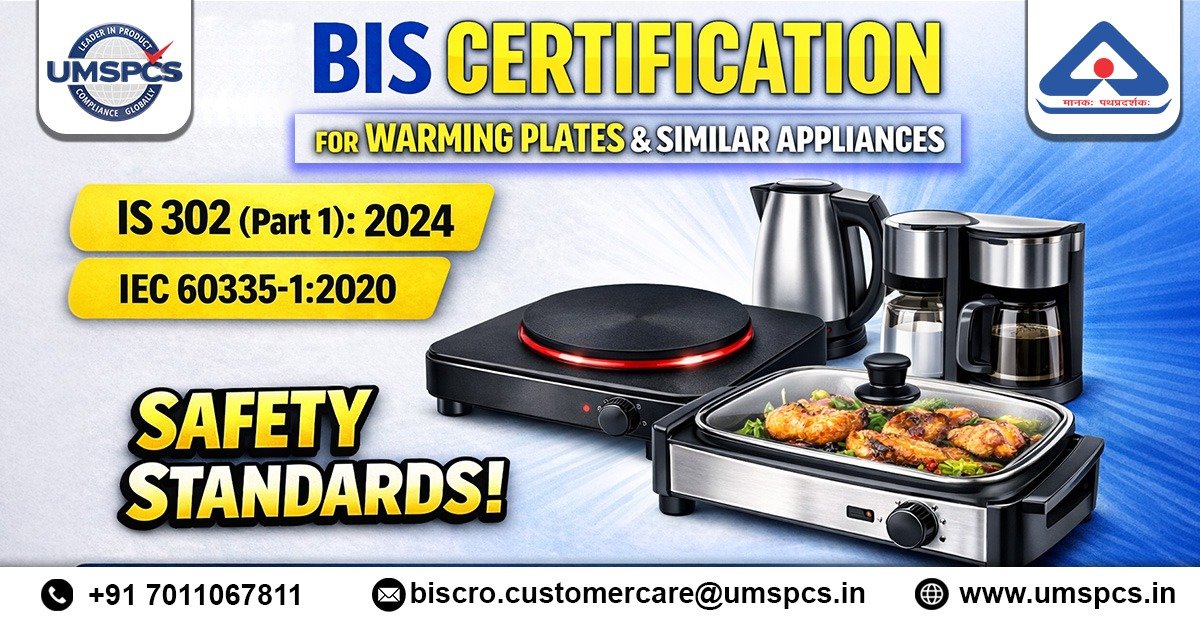
Electrical kitchen appliances are now becoming an essential part of modular households and commercial kitchens. Warming plates are required, to keep warm and ready to serve foods. It is required to get aligned with the rigid standards of safety and quality as these appliances works by using the electricity and heating components.
In India, BIS Certification for warming plates and similar appliances gives assurance to electrical appliances that they are safe to use for consumers and are in line with the Indian Standards. Warming plates and similar appliances should get aligned with the IS 302 (Part 1):2024/ IEC 60335-1:2020 standard to cover the requirements of safety for household and similar electrical appliances.
Manufacturers and importers need to get the ISI Certification or BIS ISI Certification prior to their product distribution in the Indian market.
What are Warming Plates and Similar Appliances?
Warming plates are electrical appliances which are employed to handle the temperate of cooked food. These are usually used in houses, restaurants, buffets, and catering.
Usually these examples includes the following:
- Electric warming plates
- Food warming trays
- Buffet warmers
- Hot plates
- Portable electric food warmers
As these appliances produce heath by electrical components which raises issues when not manufactured correctly, like overheating, electric shock, or fire. Therefore, BIS Certification gives surety that these appliances fulfill the safety standard prior to reaching consumers.
Understanding IS 302 (Part 1): 2024 / IEC 60335-1:2020
IS 302(Part 1):2024 is an Indian Standard which defines the safety requirements for household and similar electrical appliances. This is in line with the international standard IEC 60335-1:2020 which keeps the concentration on the common safety regarding electrical appliances.
This standards is applicable to appliances who functions at:
- Up to 250 V for single-phase appliances
- Up to 415 V for other appliances
This standard inspects a variety of safety aspects of electrical products to avoid danger.
Key Safety Requirements under the Standard
The standard verifies the following requirements:
- Protection against electric shock
- Heat and fire resistance
- Insulation and earthing protection
- Mechanical strength and durability
- Protection against overheating
- Safe operation during abnormal conditions
Such tests gives security to appliances that are safe for long term use in households and commercial environments.
Why BIS Certification is Mandatory
The Government of India holds the charge of Quality Control Orders (QCOs) for several electrical appliances. In accordance with these regulations, manufacturers and importers should get the BIS Certification in India prior to selling these products.
The BIS ISI Certification gives confirmation to the products in following ways:
- Meets Indian safety standards
- Is tested in BIS-recognized laboratories
- Is manufactured under quality-controlled processes
- Is safe for consumers
In India, Companies are not able to lawfully manufacture, import or sell such appliances without having the certification.
Certification Scheme for Warming Plates
Warming plates and similar appliances usually come under the ISI Certification scheme (scheme I) of the Bureau of Indian Standards.
In accordance with this scheme, manufacturer should must:
- Submit an application to BIS
- Get their product tested in BIS-approved laboratories
- Undergo factory inspection
- Comply with Indian Standard requirements
Once successfully evaluated BIS gives a license to employ the ISI mark on the product.
Documents Required for BIS Certification
Manufacturers who are applying for ISI certification should must upload the certain paperwork, which consists of the following:
- Business registration certificate
- Manufacturing unit details
- Product technical specifications
- Test reports from BIS-approved labs
- Quality control documents
- Factory layout and machinery details
- Trademark authorization (if applicable)
These documents assist BIS which checks the authenticity and quality control procedure of the producer.
BIS ISI Certification Process for IS 302
1. Product Evaluation and Standard Identification
With the goal to find the right Indian Standard and certification process, the product will be assessed.
2. Documentation Preparation
Manufacturers are needed to prepare complete records, like the following:
- The technical details
- representations of circuits
- Specification of the component
- A procedure for quality control
- Descriptions of the manufacturing process
3. Testing at BIS-Recognized Laboratories
In order to verify conformity towards BIS safety and performance standards, samples of the product undergo examination in approved labs.
- Inspection of the Factory
For the purpose to verify that manufacturing procedures and quality control systems correspond to standards, BIS may carry out live inspections.
5. The acceptance & Packaging
The manufacturer receives a license to use the ISI Mark only if the product and factory meet the BIS requirements.
Step 6: Check in and Renewal of previous certification
Certification in BIS is removable. To promise ongoing compliance, sample testing and surveillance inspection should take place constantly. After some time, licenses are meant to get renewed.
Performing this step can be challenging, particularly among foreign producers or those who were getting into the Indian market for the first time
Implementation Timeline Under QCO 2025
To make a smooth process, the government established a progressive start depending on the size of the company.
Dates of compliance:
| Enterprise Type | BIS Compliance Required From |
| General manufacturers (other than MSMEs) | October 1, 2025 |
| Small companies | January 1, 2026 |
| Micro business | April 1, 2026 |
Legal penalties and company image might get affected if you ignore such deadlines.
Penalties for violation of QCO 2025.
The Bureau of Indian Standards (BIS) Act of 2016 applies penalties on any individual or organisation that violates the BIS QCO 2025.
Possible consequences consists of the followings:
- Serious financial consequences.
- Seizure of a product that violates the rules.
- BIS suspension or cancellation of licence.
- Lawsuits.
- Limitation on imports and difficulties with customs clearance.
Not following compliance can impact your company’s reputation.
Timeline for BIS Certification
The usual timeline for certification is as follows:
| Step | Estimated Time |
| Application & documentation | 1–2 weeks |
| Product testing | 3–4 weeks |
| BIS review and approval | 2–3 weeks |
Total Time: On an average it requires 6–8 weeks which is based upon product complexity and correctness of paperwork.
BIS Certification Fee Structure
The amount of BIS Certification is based upon the type of product, testing requirements, and location of manufacturing.
| Fee Component | Approx Cost |
| BIS Application Fee | ₹1,000 |
| Testing Charges | ₹25,000 – ₹50,000 |
| Factory Inspection Charges | ₹7,000 – ₹10,000 |
| Annual License Fee | ₹1,000 |
| Marking Fee | As per BIS guidelines |
Note: Actual amount may vary due to product complexity and testing requirements.
Role of a BIS Certification Consultant in India
Getting BIS Certification can be difficult because of documentation, testing process, and regulatory requirements. BIS Certification Consultant in India can assist your businesses to get simpler process.
Professional consultants offers the following:
- Application filing support
- Product testing coordination
- Documentation preparation
- Factory audit assistance
- BIS license approval support
How UMSPCS Can Help
The IS 302 might seem difficult to get a BIS Certification without getting any expert assistance.
How UMSPCS offers assistance:
- Inspection of product effectiveness under QCO 2025.
- Finding the right Indian standards.
- Preparation and confirmation of documentation.
- Interaction with the BIS and laboratory testing.
- Uploading enquiries and keeping an eye on them.
- Services for MSMEs, importers, and manufacturers for fast approvals
- Minimal chances of rejection or failure.
Our professionals assure that your company is fully compliant, legally secure, and market-ready.
Read more also: BIS Certification for High Density Polyethylene Pipe for Sewerage
Conclusion
Warming plates and similar appliances are mostly utilised in homes and commercial kitchens, which makes the safety and quality more essential. The IS 302 (Part 1): 2024 / IEC 60335-1:2020 is an Indian standard which gives surety that these appliances are in follow up of rigid requirements of electrical and mechanical safety.
Receiving the ISI certification or BIS certification in India is compulsory for manufacturers and importers who are seeking to distribute these products into the Indian market. The BIS certification for warming plates and similar appliances not just make sure of compliance in accordance with government regulations but also boosts the trust among consumers.
By hiring an professional experienced consultant like UMSPCS, businesses can get the BIS ISI certification in a simple and efficient manner by ensuring that their products follow up with every required regulations and can get the market access without delays.
Frequently Asked Questions (FAQs)
- What is IS 302 (Part 1): 2024 for warming plates?
IS 302 (Part 1): 2024 is an Indian standard for safety of household and similar electrical appliances, which consists of warming plates and food warming devices.
- Is ISI Certification mandatory for warming plates in India?
Yes. Manufacturers should get the ISI certification or BIS ISI certification to distribute warming plates lawfully into the Indian market.
- Who issues BIS Certification in India?
The Bureau of Indian Standards (BIS) holds the responsibility of BIS Certification in India where the national standard body is in charge for product quality and safety.
- How long does it take to get BIS Certification?
On an average, the BIS Certification usually requires 6-8 weeks which is based on product testing and verifying the documentation.
- How can UMSPCS help with BIS Certification?
UMSPCS, provides end-to-end assistance to your company which helps in completing the certification process smoothly and efficiently.
❓ Ask a Question
Have any doubts? Fill the form below and our team will respond shortly.