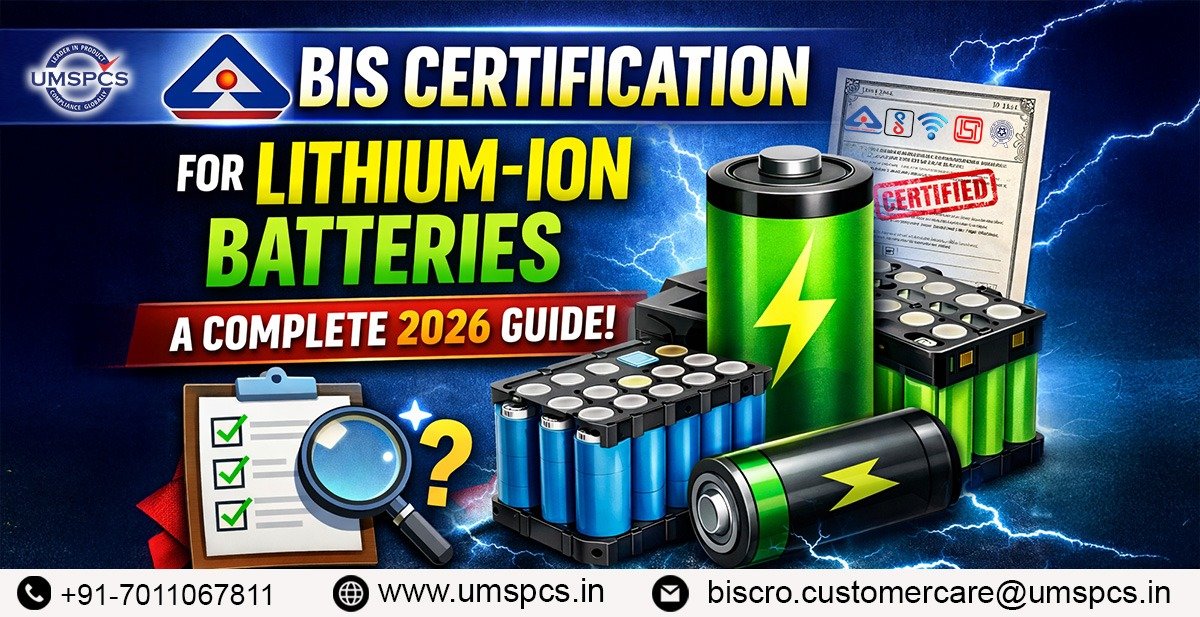
Lithium-ion batteries are currently mandatory in India’s rapidly expanding financial system, which has been powered by smart devices, renewable energy, and electric cars. However, there is a high threat to safety because of high energy density, is either accidental fires, explosions, or failures in goods that can put consumers in danger, destroy property, and harm a brand’s reputation.
Although lithium-ion batteries are assembled, imported, or sold in India, the Government of India requires BIS (Bureau of Indian Standards) certification to promote product safety, performance, and regulatory compliance. Let’s see what this looks like and how UMSPCS, an effective compliance partner, can help you everywhere along the way.
What Is BIS Certification?
The Bureau of Indian Standards (BIS) is India’s national standards body that gives the ISI mark used for quality certification. It verifies its compliance with the essential Indian Standards (IS) and provides security and quality in India. The product’s status of compliance with Indian performance, safety, and technical standards will only be verified through BIS certification.
Does BIS certification needed to sell Lithium-Ion Batteries?
BIS Certification for Lithium-ion batteries are extremely powerful storage devices. failing to provide proper testing and regulations, they must can:
- become extremely hot or catch fire;
- Fail underneath structural or heat stress;
- Cause electrical problems;
- Put lives in danger or damage equipment.
BIS certification indicates that these types of batteries comply with demanding safety and performance standards before entering the Indian market.
Which Standard Applies?
In India, the single most primary requirement for lithium-ion batteries is:
IS 16046 (Part 2):2018 and IEC 62133-2:2017 deal with portable lithium-ion cells and batteries used in consumer electronics, electric vehicles, energy storage systems, telecom backup systems, drones, and more.
This norm examines safety under environmental, mechanical, and electrical stresses, including these:
- Overcharge and overload
- Short circuit protection
- Forced release
- Impact, falls, vibration, and shock checks
- Heat abuse and the cycle of temperature.
Each investigation looks at safety under expected abuse all through the battery’s life cycle.
Who Must Get BIS Certification?
As per Indian regulations, looking for BIS certification is a legal requirement for those attempting to import, manufacture, sell, or provide lithium-ion batteries in India. This includes:
- Local producers
- International producers
- Importers and dealers
- OEMs with embedded batteries (such as in electronics or EVs)
- Providers of energy storage systems
For the Indian market, a battery still needs BIS certification even if it has safety permits from other organisations (such as UL or IEC).
The BIS Certification Process — Step by Step
The BIS certification procedure for lithium-ion batteries normally operates as follows:
Identify Applicable Standard
At first, find out suitable Indian standards for your product, like IS 16046 ( part-2)
Appoint Authorised Indian Representative (AIR) (If Foreign)
Foreign brands have to hire an Authorised Indian Representative (AIR)—a legally authorised agent who is accountable for submitting and dealing with BIS officials on behalf of the manufacturer.
Testing in BIS-Recognised Lab
Products are required to be tested in Indian labs that have received BIS approval. Foreign reports on tests are usually not approved. This indicates that you have to arrange testing in India through approved laboratories.
Prepare and Submit Application
Use the BIS Smart Registration portal to submit the application online, making sure to include:
- Technical details and datasheets
- Test results from a lab approved by BIS
- Information about the factory and business
- Documentation of the manufacturing process and quality control
BIS Evaluation
BIS representatives review your application after it is submitted and may request additional details or clarification.
Certification Grant
The registration certificate with a unique R-number is issued by BIS following a successful evaluation and compliance verification. You may now stamp the BIS Standard Mark on the batteries and packaging
Validity and timeperiod of the certified product
- The average time is anywhere between one and three months based on the quality of documentation and laboratory tests approved by BIS officials.
- Validity of a certified product can last upto 2 years, you need to renew your previous certification before reaching the endline.
Possible Effects of Not Being Able to Comply
Selling or importing lithium-ion batteries in the absence of a valid BIS certification might give rise to:
- Plenty of fines and penalties
- Product seizures or restrictions
- Damage to brand reputation
- Problems with customs clearance
Preserving compliance from the start protects your business and your clients.
Problems Manufacturers Commonly Face
There are several moving components in the demanding BIS certification process:
- Complicated documentation
- Strict testing requirements
- Technical file setup
- Factory inspection (if relevant)
- Rapid submission and discussion with BIS representatives
For this reason, a lot of businesses opt for expert assistance to speed up the procedure.
How the UMSPCS compliance process operates:
To enhance productivity and accuracy while making it simpler to use, UMSPCS uses an orderly and systematic process.
1. Initial examination and approach
As every product carries its own specific certification, it continues with a thorough examination of the product that matches the Indian regulations and standards.
2. Coordinating testing and documentation
They ensure that your test reports conform to all Indian standards by preparing the necessary documentation and collaborating with BIS-approved testing labs.
3. Assistance with factory inspection and reviews
They maintain your certificate requirements with certification and can help organise your company for inspection.
4. Legal inspection and submission of application
From receiving a certificate to applying by resolution, UMSPCS handles each step of BIS on your behalf.
5. After-certification services
They support you with monitoring, usage mark guidance, renewals and compliance updates as the rules change.
Reasons to choose BIS compliance with UMSPCS?
For quick approvals and long-term success, hiring the right compliance partner is necessary:
- Competency & Experience
They consist of skilled business experts who have extensive knowledge of Indian standards & regulations.
- Complete support
From first assessments to after certification renewal, UMSPCS handles each and every step of your compliance journey.
-Saving you time, stress, and money under the guidance of experts, BIS consultants.
- An open and client-oriented approach
The UMSPCS approach is clear and focused on the client’s requirements.
- QuickApprovals
Through coordinated laboratory testing, documentation, and expert monitoring, UMSPCS allows for a quicker approval cycle for easy market access.
- International and National Level Coverage
They support both domestic and foreign businesses to grow in the Indian market, serving both clients domestically and internationally.
In Conclusion
Lithium-ion battery BIS certification is an essential requirement in today’s strictly controlled and competitive market. According to the BIS standards isi mark, which take care of your business and customers by building trust through providing certified products to manufacturers, importers, or brand owners.
By understanding the whole procedure through an expert consultancy like UMSPCS, which reduces the chances of compliance failing, penalties, and concentrates on the new creation of products and scaling up throughout the journey.
Frequently Asked Question(FAQs)
Q1. Why do we need to file an application before selling Lithium-Ion batteries into the Indian market?
A- The following organisations need to become certified in BIS:
- Indian producers
- International producers
- Importers and brand owners
- OEMs that contain lithium-ion batteries in their goods
An Authorised Indian Representative (AIR) must be chosen by foreign manufacturers.
Q2. How can BIS certification be aided by UMS Product Compliance Services (UMSPCS)?
A– End-to-end BIS certification assistance is provided by UMS Product Compliance Services (UMSPCS), which includes:
- Finding the relevant IS standards
- Planning for product compliance
- Coordination with BIS-approved labs
- Documentation and submission of applications
- Help with factory inspections
- After certification support
We have a team of experts and professionals in this field who made this complex compliance journey a smooth one.
Q3. What occurs if lithium-Ion batteries are marketed without BIS certification?
A- Failure to comply could give rise to:
- Seizure of a product
- Rejection of imports at borders
- High penalties
- Legal action
- Cancellation or suspension of a license
Compliance is a requirement for law and not optional.
Q4. At what position does BIS certification contribute to the safety of lithium-ion batteries?
A- BIS certification guarantees:
- Risk reduction for explosions and fires
- Electrical and heat safety
- Protection of consumers
- India’s legal market access
It boosts confidence, trust, and the extended viability of businesses.
Q5. How much does BIS certification for lithium-ion batteries take to obtain?
A- The cost varies depending on:
- The quantity of models
- Testing fees imposed by BIS-recognised labs
- BIS government fees
- Fees for consulting
The total expense usually varies according to the length of testing and the complexity of the product.
❓ Ask a Question
Have any doubts? Fill the form below and our team will respond shortly.