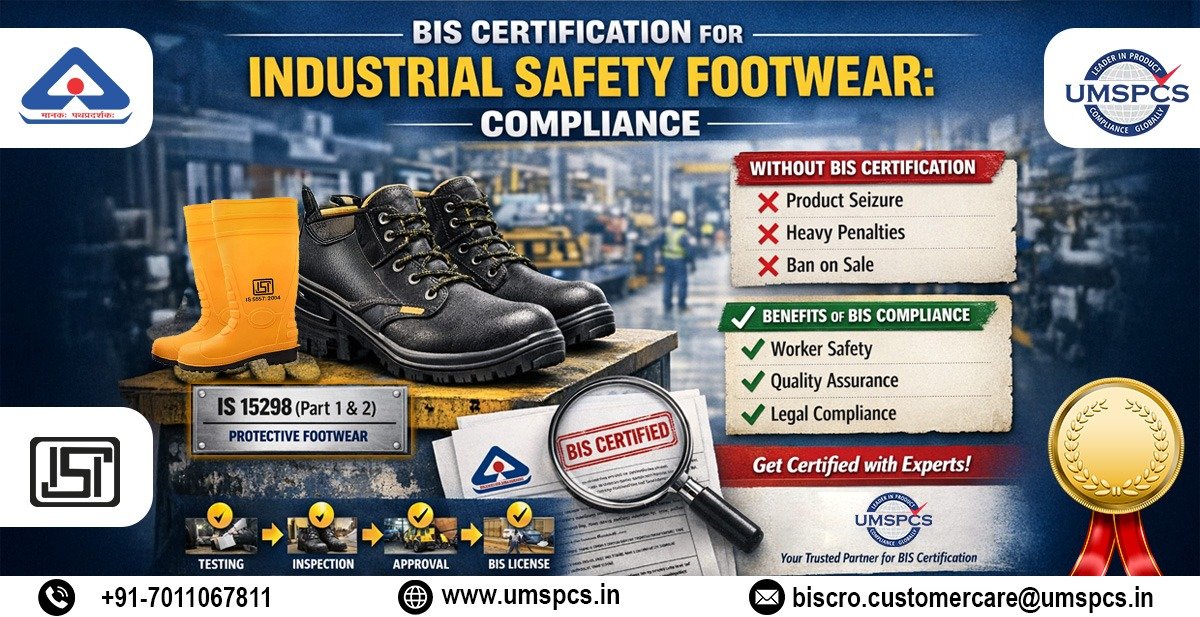
The law of India has demanded the BIS certification from Industrial Safety Footwear to make sure the product safety, including shoes, boots, and other working footwear. As the time changes, the Bureau of Indian Standards (BIS) widely spreads its quality control orders (QCOs), demanding BIS certification for products like industrial shoes, rubber boots, PVC boots, and other safety footwear.
If one promises safety in the Indian market, and gains trust among customers in line with the highly strict legal requirements to meet Indian safety Standards. Manufacturers and importers should know about the BIS certification.
What Is BIS & Why Certification Is Important
The Bureau of Indian Standards (BIS) is India’s national standards that gives the ISI mark used for quality certification. It verifies its compliance with the essential Indian Standards (IS) and provides security for the workplace.
Compulsory vs. Voluntary Certification
BIS certification may be required or complementary, depending on the product’s category.
- Compulsory
- Voluntary but market-preferred
Industrial safety footwear is currently covered by essential standards, requiring BIS certification even before selling, delivery, or arrival into India, as per recent regulatory changes.
What Does BIS Cover for Industrial Safety Footwear?
A variety of requirements is met by BIS certification for safety footwear, with a focus on protection for employees, quality of material, longevity, and health and safety performance under Indian workplace and environmental conditions. Rubber, polymeric, and leather-based industrial footwear requirements are common standards.
Types of Safety Footwear Covered
Industrial and protective rubber boots are two typical categories.
- PVC work boots
- Polyurethane-soled safety shoes
- Boots made of leather for heavy machinery
- Safety shoes for work.
Every product category has to approve the required Indian Standards (IS) codes, such as IS 5557, IS 12254, IS 13893, and IS 16645, to legally enter into the Indian market.
The Importance of BIS Certification
1. Legal Requirement
Industrial safety footwear, including Indian OEMs and foreign brands, cannot be lawfully produced, imported, or sold without a valid certification due to BIS QCOs’ growing product coverage.
2. Consumer Safety & Trust
The footwear goes through inspection for strict safety and performance tests, as per the BIS or ISI mark, which shows quality assurance. Both distributors and buyers develop confidence as a result.
3. Market Access & Compliance
Products without a BIS license:
- Penalties and legal proceedings
- Market losses compared with certified products are more widely accepted and have easier access to retail, wholesale, and tender markets.
- Risk of being seized by customs
BIS certification can often be an essential distinction since industry buyers, corporate buyers, and institutional procurement processes choose certified products.
4. Competitive Advantage
BIS certification can often be an essential distinction since industry buyers, corporate buyers, and institutional procurement processes choose certified products.
How BIS Certification Works for Safety Footwear
Step 1: Identify the correct Standard
Finding the Indian Standard (IS) that best fits your product based on its material is the first step.
Step 2: Product Testing
Footwear needs to be looked at for several factors, including:
- The ability to resist slipping
- Strength solely
- Resistance to absorption
- Tolerance for chemical exposure
- Resistance to compression
Testing needs to be done in labs approved by BIS officials.
Step 3: Documentation Preparation
Typical documents consist of:
- Technical specifications
- Details of the materials and manufacturing
- Procedure for factory quality control
- Test results
- Proofs of brands and trademarks.
This is frequently the most difficult and careful step in the procedure.
Step 4: Application Submission
All documentation has to be uploaded through the official BIS portal in line with the relevant schemes (ISI or FMCS for foreign manufacturers).
Step 5: Factory Audit
Manufacturing facilities may be inspected by BIS officials or chosen auditors to verify compliance with product standards and documentation.
Step 6: License Grant & Surveillance
After approval, BIS issues a certification license that permits products displaying the ISI mark. In addition, BIS periodically conducts market sampling and inspections. Renewal cycles are common for certifications.
Schemes That Apply to Safety Footwear
A variety of BIS conformity assessment schemes may be suitable depending on your circumstances:
1. ISI Certification (Domestic Manufacturing)
This is the standard strategy for product compliance for Indian manufacturers.
2. FMCS (Foreign Manufacturer Certification Scheme)
FMCS permits foreign companies to apply for a BIS license, which often calls for an Authorised Indian Representative (AIR), in order to import safety footwear into India.
3. Scheme-X Certification
This relates to products covered by omnibus technical regulations, in which particular product standards are not directly covered by FMCS or ISI. Navigation is made possible by a partner such as UMSPCS.
Challenges in BIS Compliance
Many run into challenges even with a well-defined procedure:
- Complicated documentation
- Lack of clarity regarding relevant standards
- Slot delays for laboratory testing
- Problems with inspection scheduling
- Updates and management of renewals
Compliance consultants like UMSPCS can offer a strategic edge in this situation.
How UMSPCS Helps with BIS Certification
UMS Product Compliance Services (UMSPCS) is a dependable partner that can assist with handling compliance from start to finish if you are looking to simplify the BIS certification process for industrial safety footwear.
Who Are They?
In India, BIS certifications, licensing, product testing coordination, documentation support, and inspections are the areas that matter for UMSPCS, a full-service regulatory and compliance consultancy.
Core Services Offered by UMSPCS
Compliance Strategy & Assessment
They can help in identifying the appropriate IS standards, compliance pathways, and BIS scheme.
Documentation & Testing Facilitation
Technical dossiers are prepared by UMSPCS, which also arranges testing with approved labs and promises that the outcomes meet BIS requirements.
Factory Audit Support
They assist with planning, preparing, and carrying out factory inspections, making sure that manufacturing controls and quality systems are prepared for inspections.
Application Filing & Follow-Up
UMSPCS handles every aspect of BIS interaction, from online submissions to live assistance during approval cycles.
Post-Certification Services
Additionally, they manage compliance change management, renewal paperwork, checking inspections, and alteration of regulations.
Support for Foreign Manufacturers
UMSPCS supports foreign brands in dealing with regulatory inquiries, FMCS filings, and the appointment of Authorised Indian Representatives.
Benefits of Partnering with UMSPCS
The following explains why UMSPCS is a popular choice for BIS certification support among manufacturers and importers:
- More rapid responses because of simplified processes
- Proficient management of difficult documentation and testing
- Strong connections with authorities and labs
- Higher success rates and lower rejection risks
- Continuous updates and assistance with compliance
In Conclusion
BIS certification for industrial safety footwear reflects that so many attempts are made to make sure worker safety, product quality, and identical manufacturing standards for better growth. To operate in this compititive indian market legally, both domestic manufacturers and foreign manufacturers need to achieve the BIS certification and the ISI mark.
We at UMSPCS made this procedure easier for you by working with compliance experts and a skilled team providing complete guidance.
❓ Ask a Question
Have any doubts? Fill the form below and our team will respond shortly.