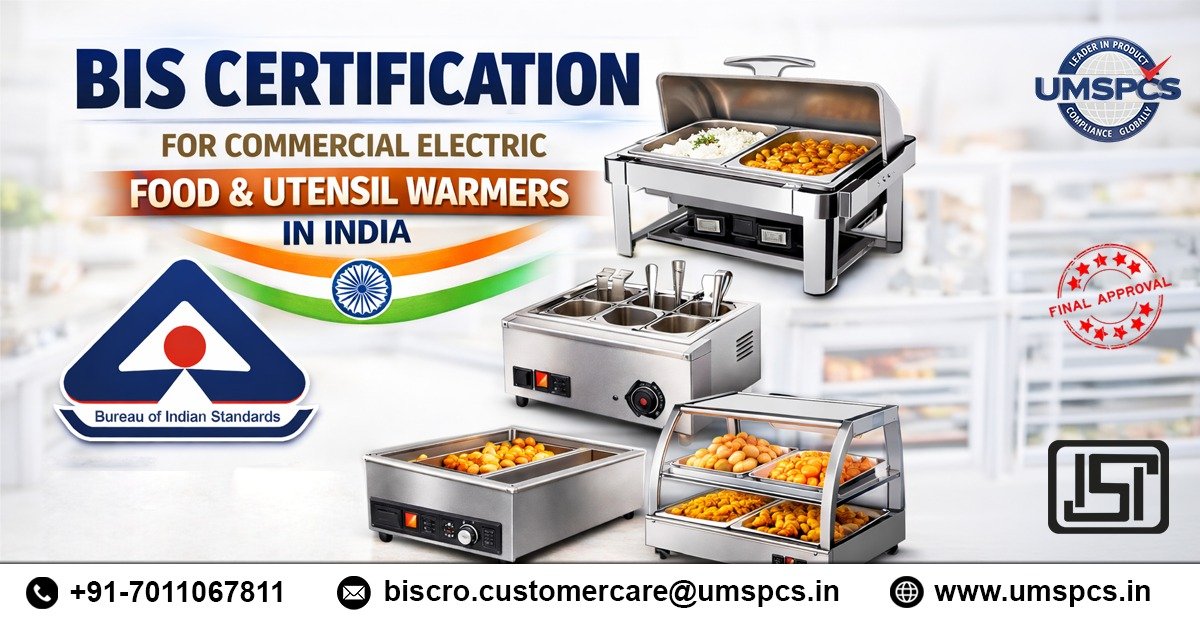
Restaurants, hotels, canteens, & educational kitchens depend on the Commercial electric food and utensil warmers, which consist of heating storage shelves, electric immersion units, warming components, and dish warmers. Despite this, these products require meeting high-quality and safety requirements defined by the Bureau of Indian Standards (BIS), before they are allowed to be manufactured, imported, or distributed all across India.
We’ll look for the basics of the BIS Certification for commercial electric food and utensil warmers in India, and demonstrate why it’s necessary for food and utensil warmers, and provide an easy, simple guide to accomplish compliance in this blog. We are going to also discuss about how professional support can be provided by a BIS consultancy like UMSPCS, which can make the whole thing more efficient.
What Is BIS Certification and Why Does It Matter?
The Bureau of Indian Standards holds the responsibility of building standards for product quality, releasing Indian standards (IS), and managing compliance based certification schemes.
The products you sell comply with Indian security, reliability, and overall quality if it has given the BIS certification. According to the Quality Quantity Orders (QCOs) provided by the Indian government, which serves more than a marketing scheme for utensil warmers, which is actually mandated by the law. Commercial electric warmers cannot be treated or brought into the Indian market after March 19, 2026, as long as they’ve got the current BIS certification & shows the ISI mark.
BIS Certification must be maintained because of the following purposes:
- Promises product safety & reliability
- Improvements in trust among consumers and the brand image.
- acceptable for international as well as domestic markets in India
- assists in avoiding penalties, bans, or limitations on markets over failure to comply
Which Standards Apply to Electric Food and Utensil Warmers?
Usually addressed in IS 302 (Part 1):2024, which defines security requirements during the electrical insulation of heating equipment, heat transfer, and general layout requirements. businesses electric food and utensil warmers are somewhat subject to electrical equipment safety guidelines.
These regulations promote the safety of devices employed within difficult business settings for both users and consumers.
Step-by-Step BIS Certification Guide
Although the BIS certification for commercial electric food and utensil warmers in India might seem complicated, it is possible to make it organised and easy with the right strategy and preparation.
1. Identify Applicable Standards
Examine the appropriate Indian Standard (such as IS 302 (Part 1):2024 for electric commercial warmers) and verify to what extent your product meets the requirements under a particular QCO prior to launching the certification process. By taking this stage of the process, possible postponements and confusion can be avoided.
Advice: For evidence of which is the most recently issued in force standard, visit the governmental BIS web page or discuss it with a compliance trained professional.
2. Conduct Product Testing in BIS-Recognised Labs
Your substance has to undergo examination in an Indian laboratory that has been officially authorised by the BIS. Electrical safety, insulation integrity, temperature control performance, and heating element materials are some of the factors that are tested within these labs. Among the most important components of your application acceptance is the evaluation outcome that is generated.
Note: As long as test reports are current and meet BIS requirements, they tend to be acceptable for submission.
3. Prepare Documentation
Plenty of documents must be submitted for BIS certification. Common requirements involve the following :
- Complete product specs and drawings
- Procedures for quality control
- Information about the factory and manufacturing
- Test reports from recognised labs
- Certificates of trademark (when needed)
Approval times are immensely decreased when both of these are put together prior to submitting them.
4. Submit Your Application to BIS
The BIS portal has been utilised for submitting applications through the internet. Your test outcomes, supporting documentation, and any required fees are going to be handed in by you or the person representing you. BIS initiates the assessment and confirmation procedure right away as the application arrives at it.
5. Factory Audit by BIS Officials (If Applicable)
BIS might carry out live factory audits for ISI mark certifications with the aim to make certain that production checks and manufacturing procedures conform to Indian standards. During this inspection, facilities need to have quality guidelines and documentation prepared.
6. Check in and Renewal of previous certification
The BIS License is in charge of the Bureau of Indian Standards after getting the certification through the inspection, verification, and process instruction. After the approval is granted, they are allowed to show the ISI mark on their products and their packaging, which will serve as an important symbol for Indian consumers.
7. Renewal and After Certification Services
Receiving BIS Certification through an uingoing inspections. When the standards get modified, it is your role to keep the compliance by regular audits, renewals, and notification of updates by getting BIS certification. You can benefit by avoiding a good reputation by preventing it from fines and ensuring continuous compliance.
Read more about also: BIS Registration for Electronic Products
How Professional Support Simplifies Your BIS Journey
UMS Product Compliance Service (UMSPCS)– Trusted BIS Certification Consultant in India, which offers complete guidance by experts from initial stage to final approval. UMSPCS is a complete regulatory consultancy that assists manufacturers and brands to receive BIS certification as well as other required regulatory approvals by avoiding delays and stress.
What UMSPCS Offers
UMSPCS simplifies the whole BIS Certification journey by providing complete guidance from product evaluation to the license permit.
UMSPCS Services Include:
- Testing of products in BIS approved labs only.
- Preparing complete paperwork
- Submission of application online through the BIS portal
- Preparing for factory audits
- Coordinating with BIS and handling the query
- Support in the approval of license
- Support in renewal, amendment, and monitoring
UMSPCS works with Indian manufacturers, importers, and foreign manufacturers, ensuring faster approvals and zero compliance risks.
In Conclusion
Additional properties than simply an obligation by law, BIS certification for commercial electric food and utensil warmers in India has become proof of the superior quality and safety of the product. Obtaining certification earlier builds your brand over achievement in Indian markets, as mandatory compliance has been put in place for 2026 and beyond.
Regardless of whether you’re a distributor, importer, or manufacturer, you may gain BIS certification easily and quickly by executing the procedures listed here and working together with an experienced compliance partner.
Frequently Asked Questions (FAQs)
- Q. Is the BIS certification compulsory for commercial electric food and utensil warmers in India?
A- Yes. The imposed regulation through the Bureau of Indian Standard make specific commercial electrical appliances should must have the BIS certification and diaply the ISI mark before aiming to sell or brought anything in India.
- Q. Which of the BIS standard suitable for the electric food and utensil warmers?
A- Products that usually came under the safety standard, which is IS 301 (Part 1) consists of electrical appliances in line with any similar standards suitable to commercial heating equipment.
- Q. Who among us really needs the BIS certification?
A- Both the manufacturers from India and foreign, importers, and brand owners who’s aiming to sell commercial electric warmers should demand the BIS compliance before entering into the Indian market.
- Q. How much time does it take to complete the BIS certification?
A- On average, 4-8 weeks is required based upon the product testing outcomes, correctness of documentation, and factory review on time.
- Q. Can a consultant support with the BIS certification?
A- Yes. Professional consultants like UMSPCS, who provide complete support with documentation, lab testing, application submission, and complete BIS approval process to make sure a smooth and quick compliance process for you.
❓ Ask a Question
Have any doubts? Fill the form below and our team will respond shortly.