

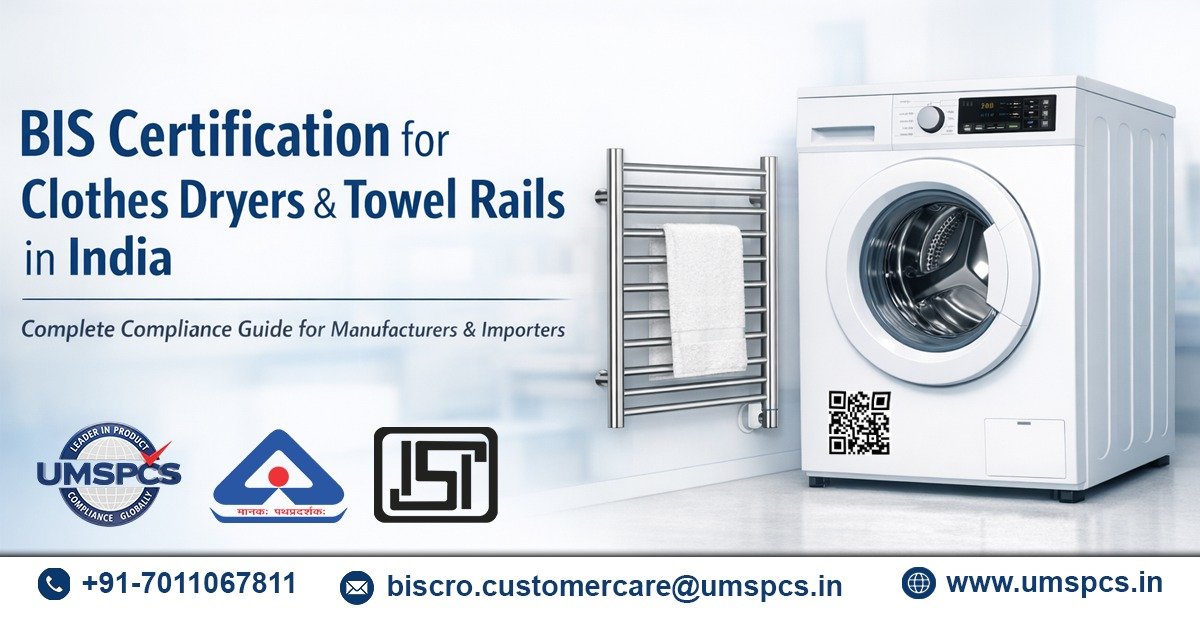
In India, there is a huge demand for modern home appliances, which include products like cloth dryer and towel rails. The Bureau of Indian Standards hold the essential safety and quality standards, to make sure that these electrical appliances are aligned before entering the Indian market.
This blog goes over what is needed for BIS certification for clothes dryers and towel rails in India, the appropriate standards, the involved stages, and how UMSPCS can promise a smooth compliance.
What is BIS Certification?
India’s national standard body, the Bureau of Indian Standards (BIS), is handled by the Ministry of the Department of Consumer Affairs and public distribution. The government Quality Control Orders (QCOs) for certification of several kinds of electrical appliances, like tower rails and clothes dryers.
Showing the ISI mark on products can only be possible when you get the approval, as this makes the consumers feel secure about the product’s quality and safety standards.
Why is BIS Certification Mandatory for Clothes Dryers and Towel Rails?
Electrical heating elements and wiring systems power towel rails and clothes dryers. They may show up major risks like the following if poorly manufactured:
- Shock from electricity
- Being too hot
- Fire risks
- Circuit short circuits
- Equipment failure
The Indian government mandated BIS certification for clothes dryers and towel rails in India, in order to reduce risks and secure consumers. IS 302 (Part 1): 2024 (IEC 60335-1:2020), it is illegal for producers, importers, and marketers to offer uncertified goods.
Penalties, product seizure, license cancellation, or lawsuits over the BIS Act are all potential consequences of noncompliance.
Applicable Indian Standard IS 302 (Part 1): 2024
Towel rails and clothes dryers usually fall under:
IS 302 (Part 1): 2024: General Requirements for the Safety of Domestic and Related Electrical Appliances
- Protection from electric shock is handled by this standard.
- Limits of temperature rise
- Resistance to insulation
- Current leakage tests
- Strength of mechanics
- Durability and fire resistance
Indian Standard IS 302 (Part 1): 2024 (IEC 60335-1:2020) Even though all products might use variations in BIS certification processes, the following steps usually take place in the basic process:
Step-by-Step: Process of BIS Certification in India
1. Product Testing
Send your samples of products to a lab approved by the BIS to ensure that they are able to verified with the correct Indian Standard.
- Inspection and Paperwork
Create material specifications, procedures, and technical documentation. To prove your compliance, submit samples of the product to a testing facility approved by BIS.
- The Submission of an Application
Using the BIS online portal, upload your application together with the necessary paperwork and test results.
- Inspection of the Factory
For the purpose to verify that manufacturing procedures and quality control systems correspond to standards, BIS may carry out live inspections.
5. The acceptance & Packaging
The manufacturer receives a license to use the ISI Mark only if the product and factory meet the BIS requirements.
6. Check in and Renewal of previous certification
Certification in BIS is removable. To promise ongoing compliance, sample testing and surveillance inspection should take place constantly. After some time, licenses are meant to get renewed.
Performing this step can be challenging, particularly among foreign producers or those who were getting into the Indian market for the first time.
Documents Required for the BIS Certification
Common documents consist of the following, even though requirements can vary a bit:
- Certificate of company incorporation
- Registration for GST
- Technical drawings for the product
- Test results from laboratories authorized by BIS
- Details of the manufacturing process
- Plan for quality control
- Documents of authorization (for foreign manufacturers)
Timeline and Validity
According to product testing and documentation preparedness, the certification process generally takes 4–8 weeks. The BIS license is tied to renewal and continuous compliance after it is granted.
Manufacturers are sometimes monitored by ongoing BIS surveillance inspections and are required to maintain an ongoing standard of product quality.
The Government of India has introduced the Safety of Household, Commercial and Similar Electrical Appliances (Quality Control) Order, 2025, making BIS Certification (ISI Mark License) compulsory for Clothes Dryers and Towel Rails before they can be sold in India.
Effective 19 March 2026, no manufacturer, importer, or seller will be permitted to legally market these products without obtaining BIS approval.
This regulation is aimed at strengthening consumer safety, ensuring product reliability, and enforcing compliance with Indian Standard IS 302 (Part 1): 2024 (IEC 60335-1:2020).
How UMSPCS Can Help in BIS Certification
The BIS Certification process consists of some necessary steps, including technical documents, lab coordination, and factory audits. Appliances that have poor quality or that are not followed by the Indian standards will get rejected and delayed.
The process is made more efficient by working together with experienced compliance experts.
Complete assistance for BIS certifications provided by UMS Product Compliance Services (UMSPCS), which involves:
Full Certification Support
Standard identification, lab coordination, documentation, submission, and BIS approval follow-up are all covered.
Before Evaluation and Compliance Verification
To avoid costly postponements, we review your product requirements and test reports before their submission.
Approved Representation for International Customers
UMSPCS can act as your Authorised Indian Representative (AIR) if you are an international manufacturer; this is an essential step for foreign applicants.
Professional Guidance on Your Preparation of Documents and Tests
We manage all your documentation to satisfy the BIS requirements and promise you that your samples will be tested in laboratories approved by the BIS only.
Ongoing Services after Certification
We support you in all phases of your compliance journey, from the initial level to certificate renewal, avoiding delays and stress for you.
BIS certification becomes faster, easier, and more affordable when you select a professional consultant like UMSPCS, who will give you services even after certification.
In Conclusion:
In order to get legal access to the Indian market for products including towel rails and clothes dryers, it is a must to get BIS certification for clothes dryers and towel rails in India. Manufacturers and importers demand to get in line with IS 302 (Part 1): 2024 and receive the ISI mark.
In the Indian market, where businesses need to promise simpler certification, build trust among consumers, and operate with confidence through being conscious of the process and when essential, take advice from the professionals.
Frequently Asked Questions (FAQs)
- Q. What is the BIS certification in India?
A- India’s national standard body, the Bureau of Indian Standards (BIS), is handled by the Ministry of the Department of Consumer Affairs and public distribution. The government Quality Control Orders (QCOs) call for certification of several kinds of electrical appliances, like tower rails and clothes dryers.
- Q. Who among us can get the BIS Certification?
A- Both Indian manufacturers and foreign manufacturers can get BIS Certification. However, foreign companies need to first select an Authorised Representative (AIR) to manage on their behalf.
- Q. Is BIS certification compulsory for clothes dryers and towel rails in India?
A- Yes. BIS certification is compulsory for clothes dryers and towel rails prior to selling products into Indian market. Manufacturers and importers need to receive certification from the Bureau of Indian Standards.
- Q. How can UMSPCS help you with BIS certification in India?
A- A- Yes. Professional consultants like UMSPCS, who provide complete support with documentation, lab testing, application submission, and complete BIS approval process to make sure a smooth and quick compliance process for you.
- Q. How much time is required to get BIS certification?
A- On average, 4-8 weeks are based upon the testing of products, the correctness of documents, and the time review of inspection.
❓ Ask a Question
Have any doubts? Fill the form below and our team will respond shortly.
1 Comment