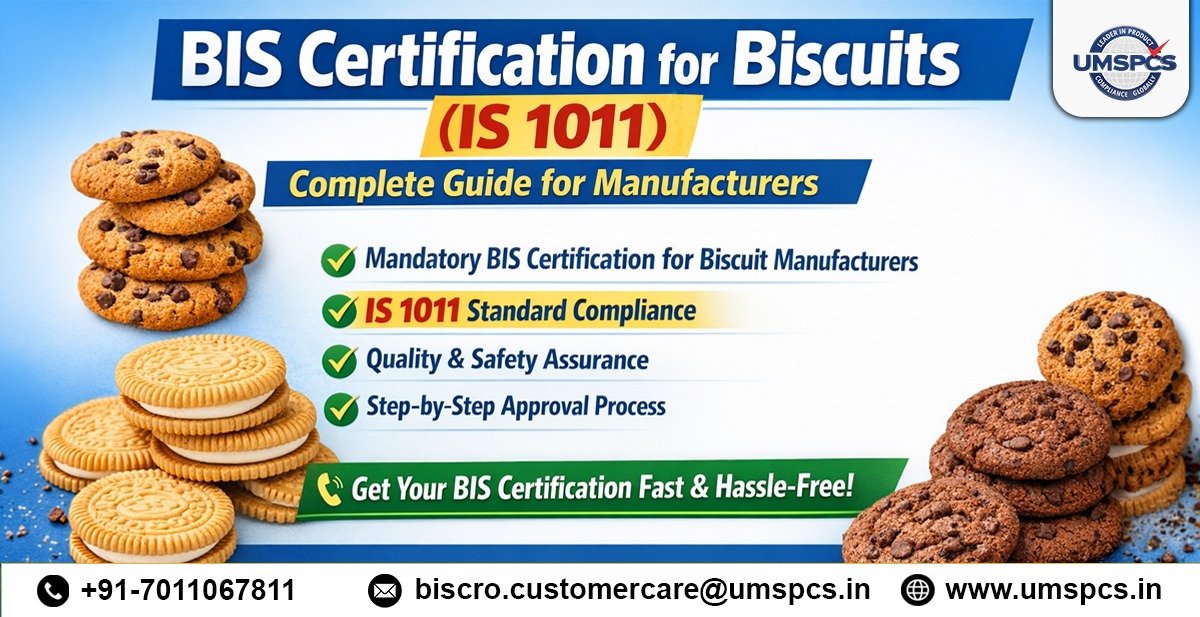
In India, biscuits are one among the most consumed food products. Biscuits are available in every house, from evening snacks to packaged food exports. Therefore, guaranteeing their quality, safety, and consistency is important. Here is why BIS certification has become necessary under IS 1011 which has a primary role in this.
In this blog we’ll demonstrate everything about BIS certification for biscuits, which consists of requirements for standards, procedure, paperwork, and how a professional BIS consultant like UMSPCS can help.
What is BIS Certification for Biscuits?
The bureau of Indian Standard (BIS) has imposed the BIS Certification which is the national standard body of India. It makes sure that the products are in line with the stated quality, safety, and functionality standards.
The applicable standard for biscuits is IS 1011:2002, which defines the requirements in relation to ingredients, manufacturing, hygiene, packaging, and labeling.
BIS Certification for biscuits is usually voluntary which has become necessary for businesses who want to boost trust, transport large retailers or export products.
Overview of IS 1011 Standard
The IS 1011 standard specifies biscuits as baked food products made from dough which might be leavened or unleavened, coated or filled.
Types of Biscuits Covered
In accordance with this standard where biscuits are classified as follows:
- Sweet biscuits
- Semi-sweet biscuits
- Crackers
- Cookies
- Specialty biscuits
Key Requirements Under IS 1011
To receive BIS Certification, manufacturers should get align with the requirements as follows:
1. Ingredients Quality
Only approved ingredients like flour, sugar, fats, milk products and additives are to be used.
2. Moisture Content
The moisture content of biscuits should be under 5% and not exceed the limit for giving surety of crispness and longer shelf life.
3. Hygiene and Manufacturing
The production procedure should align with rigid hygiene practices which consists of clean equipment, pest control, and safe handling.
4. Physical and Sensory Properties
Biscuits should must have the followings:
- Uniform texture and color
- Proper baking
- No contamination or defects
5. Packaging Requirements
Packaging should safeguard biscuits from moisture, contamination, and breakage. Food grade materials are only allowed to be used.
6. Labeling Requirements
The label of product should consist of the followings:
- Product name
- Manufacturer details
- Ingredients list
- Batch number
- Manufacturing & expiry date
- Net quantity
BIS Certification Process for Biscuits
The procedure of receiving BIS certification should have the following steps:
Step 1: Application Submission
The manufacturer uploads applications by providing product and factory details.
Step 2: Product Testing
Samples are delivered in labs approved by BIS only to make certain compliance in accordance with IS 1011.
Step 3: Factory Inspection
BIS officials do the inspection of manufacturing facilities for quality control and hygiene.
Step 4: Grant of License
BIS approved a license to show the ISI mark once verified.
Step 5: Marking and Compliance
Manufacturers should show the ISI mark on their products to make sure compliance in accordance with these standards.
Documents Required for BIS Certification
If you’re planning to get BIS certification then there are the required documents as follows:
- Business registration certificate
- Manufacturing process details
- List of machinery
- Raw material details
- Test reports from BIS-approved labs
- Quality control documents
- Packaging and labeling details
Importance of BIS Certification for Biscuit Manufacturers
Receiving an BIS certification provides various of advantages which are as follows:
1. Ensures Product Quality
It makes sure that biscuits get aligned with safety and quality standards.
2. Builds Consumer Trust
Consumers trust products with the ISI mark only as the mark guarantees reliability.
3. Market Expansion
Assist in accessing the organised retail chains and export markets.
4. Regulatory Compliance
It makes certain alignment in accordance with Indian standards and food safety norms.
5. Competitive Advantage
Certified products always win in this competitive food industry.
BIS FMCS Certification for Foreign Manufacturers
Manufacturers should get the BIS Certificate for foreign manufacturers if they are selling biscuits outside the nation or importing it into the Indian market.
The Foreign Manufacturers Certification Scheme (FMCS) enables manufacturers from foreign to get the BIS approval and sell their products into the Indian market. This procedure consists of factory audits through BIS officials and product testing in line with the Indian standards.
After the approval, foreign manufacturers are able to use the ISI mark, which gives validation to their products which is in line with the similar standards of quality like those in India.
Role of BIS Certification Consultants
Receiving authorisation by regulatory organisations may seem like a challenging and lengthy process. In order to make the procedure less complicated, numerous companies choose to work along with an Indian BIS certification consultant.
Usually, a consultant assists in the following areas:
- Preparing paperwork
- Integration of testing for products
- Submission of a BIS application
- Preparing for a factory review
- Guidelines for certification compliance
Businesses can ensure seamless approval and cut down on postponements with professional assistance.
How UMSPCS Can Assist
For producers and importers of vacuum cleaners and water suction cleaning equipment, UMSPCS gives comprehensive BIS Consulting and compliance support. Among the services they offer are help with:
UMSPCS helps with the following:
- Testing of products in BIS-approved labs only.
- Handling the paperwork accurately
- Uploading the application online by the BIS portal.
- Look over factory audits
- Interacting with BIS and managing the inquiries.
- Help in the final approval of license
- Help in renewal, amendment, and monitoring for better results
UMSPCS works together with Indian manufacturers, importer, and foreign manufacturers who give surety of quick approvals without any compliance issues. Get your certification with expert guidance as the QCO’s deadline is about to end on March 19 2026.
Read more also: BIS Certificate of Conformity (CoC): Process, Fees & Documents
Conclusion
BIS Certification for biscuits under IS 1011 gives surety that products are aligned with the high standards of quality, safety and hygiene. Although it might not always be compulsory, it is in demand for manufacturers who want credibility, market growth, and trust among consumers.
Hiring an professional experienced BIS consultant like UMSPCS can make your whole certification procedure simple and also help in getting quick approval, no matter whether you’re a local manufacturer or global exporter,
Frequently Asked Questions (FAQs)
Q1. Is BIS certification mandatory for biscuits?
No. BIS Certification for biscuits is voluntary, but it has benefits in quality assurance and boosting credibility in the market.
Q2. What is IS 1011?
IS 1011 is an Indian Standard for biscuit which defines the quality, safety and requirements of testing.
Q3. What is the validity of BIS certification?
BIS Certification is usually for 1-2 years and after that it needs to get renewed.
Q4. Can foreign manufacturers apply?
Yes. Foreign manufacturers can apply but only through the FMCS scheme.
Q5. Why hire a BIS consultant?
BIS Consultant like UMSPCS helps in simplifying the procedure, preventing mistakes, and receiving quick approvals.
❓ Ask a Question
Have any doubts? Fill the form below and our team will respond shortly.