India’s power transmission infrastructure depends mostly on superior quality conductors which make certain efficient electricity delivery instead of long distances. One among the most utilized conductors in overhead power lines is the Aluminium Conductors Steel Reinforced (ACSR).Such conductors are aligned with the Indian Standard IS 398 (Part 2) which is imposed by the Bureau of Indian Standards for handling safety, functionality, and quality.
Manufacturers who are aiming to distribute such conductors are required to get the BIS certification and utilise the ISI Mark which shows compliance in accordance with the required Indian Standards. In this blog, we will demonstrate BIS Certification for Aluminium Conductors for Overhead Transmission Purposes: Part 2 – Aluminium Conductors, Galvanized Steel Reinforced (IS 398 Part 2) which consists of its importance, procedure, and how can a professional consultant like UMSPCS will provide help.
Overview of IS 398 (Part 2) Standard
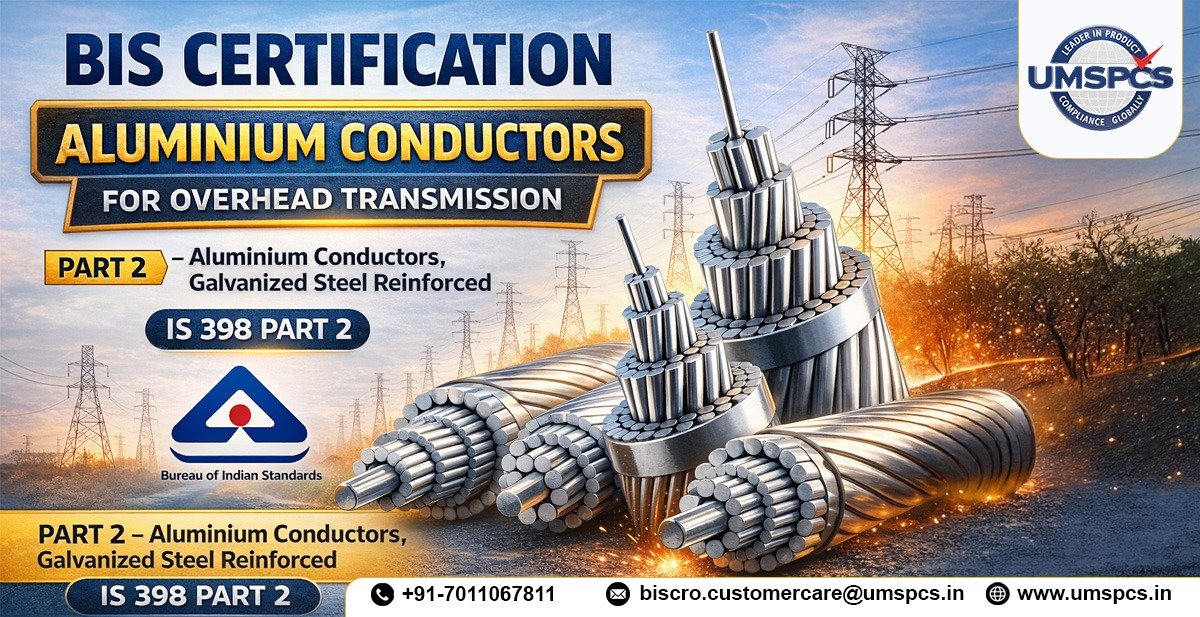
The requirements of aluminum conductors reinforced in accordance with galvanised steel wires is IS 398 (Part 2) which is used for overhead transmission lines.Such conductors are usually referred as ACSR conductors which are mostly utilised for transmitting electrical power over long distances.
Such conductors have structure which consists of the followings:
- Aluminium strands are composed for the outer layer which gives superior electrical conductivity.
- A galvanized steel core, which adds mechanical strength and durability.
This combination makes certain of solid functionality in complex conditions like long transmission spans, pressure by wind, and over load of electricity.
Conductors of ACSR are usually utilised in the followings:
- High voltage and extra high voltage transmission lines
- Power distribution networks
- Substation connections
- Long-distance electricity transmission projects
Importance of BIS Certification for ACSR Conductors
Obtaining BIS ISI Certification for aluminium conductors ensures that the product meets strict quality and safety standards established in India.
Receiving BIS ISI Certification for aluminium conductors which gives security of products that comply with the rigid quality and safety standards imposed in India.
Key Benefits
- Quality Assurance
Certification gives surety that the conductor gets aligned with the classifications of IS 398 (Part 2). - Legal Compliance
Several electrical products demand BIS certification for distribution in the Indian market. - Market Trust
Products which display the ISI mark are trusted through utilities, contractors, and agencies of government. - Improved Product Reliability
BIS Certification gives safety of conductors which can be tested for durability, conductivity, and mechanical strength.
- Quality Assurance
- Better Market Opportunities
Several of power utilised and infrastructure projects demands for certified products.
Key Technical Requirements Under IS 398 (Part 2)
The standard consists of numerous technical aspects which are related to manufacturing and testing or conductors.
1. Material Specifications
The standard specifies the composition and quality as follows:
- Aluminium strands
- Galvanized steel wires used in the core
2. Construction Requirements
ACSR conductors have concentric layers of aluminium wires which has a galvanised steel core on its surroundings.
3. Mechanical Strength
The steel core has high tensile strength which allows the conductors to get long distances instead of sagging.
4. Electrical Properties
The aluminium layers which gives surety of efficient electrical conductivity and low power loss.
5. Testing Requirements
Products should go through various tests which consists of the following:
- Tensile strength test
- Resistance test
- Dimensional inspection
- Surface condition tests
Such tests make certain that the conductor gets in line with the requirements of functionality which states in the BIS standard.
BIS Certification Process for Aluminium Conductors (ISI Mark)
Manufacturers should get the BIS certification prior to applying for the ISI mark on their products.
Step-by-Step Certification Process
- Application Submission
Manufacturers upload an application to the BIS along with the information of products and manufacturing details. - Document Review
BIS reviews the technical documents and capacity of manufacturing. - Product Testing
Samples are delivered to BIS approved laboratories for the testing in accordance with the IS 398 (Part 2). - Factory Inspection
BIS officials review the facility of manufacturers to check the quality of production. - Grant of License
BIS tools the charge of giving the incense for displaying the ISI Mark when all necessities are met.
- Ongoing Surveillance
Continuous inspection and testing makes certain of continuous compliance.
Documents Required for Certification
In general, manufacturers suffer to offer a number of things:
- Papers that are associated by establishing a business.
- Assuring the location and facility of manufactures.
- Data regarding how the product is made.
- Procedure for verifying the quality.
- Data regarding the facility of testing throughout.
- Information regarding the testing of products in labs approved by BIS only.
It is extremely significant to be equipped with correct and current documents, particularly because the deadline is getting closer on March 19, 2016.
How UMSPCS Can Assist
For producers and importers of vacuum cleaners and water suction cleaning equipment, UMSPCS gives comprehensive BIS Consulting and compliance support. Among the services they offer are help with:
UMSPCS helps with the following:
- Testing of products in BIS-approved labs only.
- Handling the paperwork accurately
- Uploading the application online by the BIS portal.
- Look over factory audits
- Interacting with BIS and managing the inquiries.
- Help in the final approval of license
- Help in renewal, amendment, and monitoring for better results
UMSPCS works together with Indian manufacturers, importer, and foreign manufacturers who give surety of quick approvals without any compliance issues. Get your certification with expert guidance as the QCO’s deadline is about to end on March 19 2026.
Benefits of Certification
There are various benefits to becoming certified according to the appropriate Indian Standard.
Various advantages of getting certification in line with the appropriate Indian Standards are as follows:
- Legal permit to sell products in the market
- In accordance with the QCO regulations
- Boosting consumer confidence
- Enhance brand credibility
- Prevent dangers associated with regulations
- Improve the institutional markets
Certified products indicate confirmation with imposed standards of quality and security.
BIS FMCS Certification for Foreign Manufacturers
Manufacturers should get the BIS Certificate for foreign manufacturers if they are selling polyethylene water storage tanks outside the nation or importing it into the Indian market.
The Foreign Manufacturers Certification Scheme (FMCS) enables manufacturers from foreign to get the BIS approval and sell their products into the Indian market. This procedure consists of factory audits through BIS officials and product testing in line with the Indian standards.
After the approval, foreign manufacturers are able to use the ISI mark, which gives validation to their products which is in line with the similar standards of quality like those in India.
Role of BIS Certification Consultants
Receiving authorisation by regulatory organisations may seem like a challenging and lengthy process. In order to make the procedure less complicated, numerous companies choose to work along with an Indian BIS Certification Consultant.
Usually, a consultant assists in the following areas:
- Preparing paperwork
- Integration of testing for products
- Submission of a BIS application
- Preparing for a factory review
- Guidelines for certification compliance
Businesses can ensure seamless approval and cut down on postponements with professional assistance.
Read more also: BIS CRS Registration for Electronic Products: Process, Cost & Documents (2026 Guide)
Conclusion
Manufacturers get the BIS Certification and the ISI mark to look over the compliance with Indian standards. Furthermore, foreign manufacturers export such conductors in India to apply through BIS FMCS.
With the assistance of professional consultants like UMSPCS, businesses can get the certification smoothly and efficiently while also making certain that the compliance is in line with the regulatory requirements.
Frequently Asked Questions (FAQs)
- What is IS 398 (Part 2)?
IS 398 is an Indian Standard which defines the requirements for aluminium conductors reinforced with galvanised steel used in overhead transmission lines.
- Is BIS certification mandatory for aluminium conductors?
Yes. Manufacturer should get the BIS Certification and show the ISI mark to make certain
compliance in line with the Indian standards.
- What is BIS FMCS?
BIS FMCS is the certification programme which is for foreign manufacturers who’s exporting products to India.
- What is the ISI Mark?
The ISI mark shows that the products align with the BIS quality and safety standards.
- How can UMSPCS help with BIS certification?
UMSPCS gives you complete assistance with paperwork, application submission, coordination with testing and regulatory compliance for BIS certification.
❓ Ask a Question
Have any doubts? Fill the form below and our team will respond shortly.