In construction sites, manufacturing factories, stores, mining areas, and other risky workplaces, worker safety helmets are essential for employee safety. These helmets have been designed to protect the head from harm caused by falling things, electrical risks, and unwanted accidents. However, a safety helmet’s function is based just on its build quality and conformity to established standards.
Industrial safety helmets in India are made to meet various safety and performance standards because of BIS certification. Anything you desire to know about BIS certification for industrial safety helmets has been addressed in this blog, including the requirements, the certification process, manufacturer liabilities, and how UMSPCS, along with other compliance professionals, can help.
Defining the BIS Certification?
The Bureau of Indian Standards (BIS) is India’s national standards that gives the ISI mark used for quality certification. It verifies its compliance with the essential Indian Standards (IS) and provides security for both workplace and public consumption.
BIS certification must be obtained for industrial safety helmets for the purpose to promise accuracy, longevity, and safety. The helmet showing the ISI Mark following certification proves that compliance satisfies all Indian safety standards.
BIS Certification for Industrial Safety Helmets
Workers are at risk in their industrial work area, especially for head injuries due to the dropping of any tool, supplies, or random accidents. Security helmets can minimise these risks, as assured by BIS certification.
Important Reasons Why BIS Certification Is Essential:
For Worker Safety: Damage resistance and injury protection have been verified for certified helmets.
Legal Compliance: Certified personal protective equipment (PPE) is a must by various workplace safety regulations.
Quality Protection: BIS confirms high standards of product that are maintained through manufacturing batches.
Less Liability: Employers who wear certified helmets are safe from penalties or fines.
Safety and Trust: When we wear helmets with tested quality standards, workers feel more secure and comfortable.
Applicable BIS Standard for Industrial Safety Helmets
Relating to industrial safety helmets, the main Indian Standard that exists is:
IS 2925 – Industrial Safety Helmets
The following helmet requirements are provided in this standard:
- Helmet protective shell thickness and strength
- Impact on soaking ability
- Barriers to exposure
- Properties of electrical insulation
- Chin strap capacity and life span
- cosy fit, and the ability to adjust provided by the helmet
According to the purpose for which they were created, helmets made for specific environments could be required to conform to extra safety regulations.
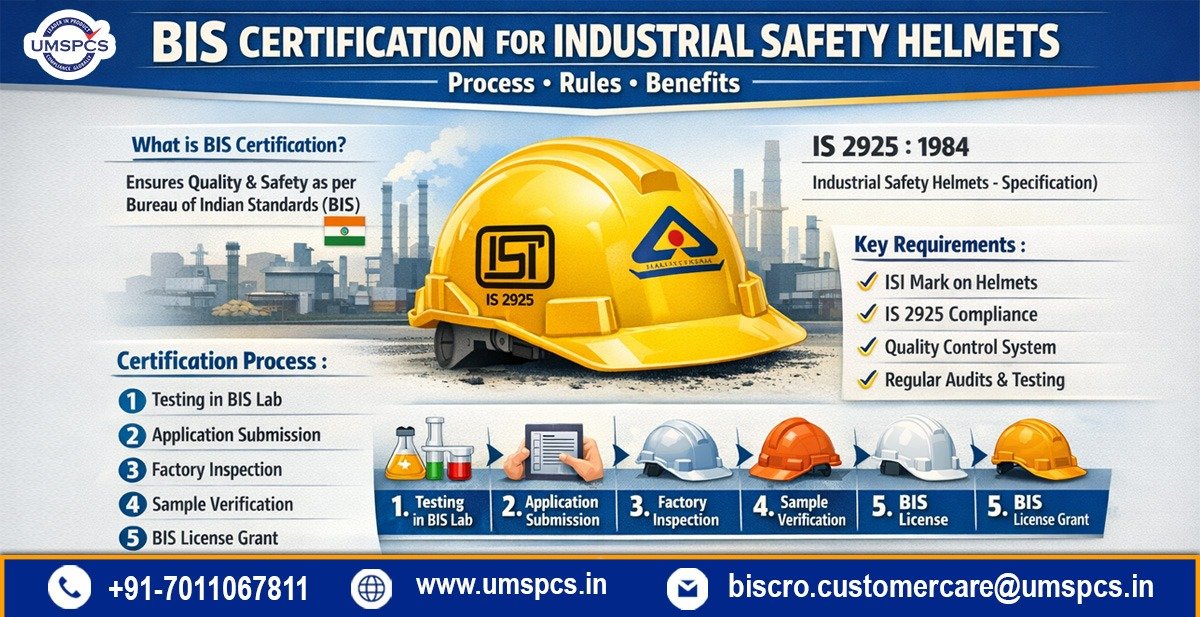
BIS Certification Process for Industrial Safety Helmets
The process for being certified in BIS is tightly controlled and structured. For proper adherence to IS 2925, manufacturers have to take specific measures.
Step 1: Find the Required Standard
Manufacturers have to keep an eye on all test requirements and should confirm that they meet the required Indian Standards (IS) 2925.
Step 2: Product Testing
Workplace safety helmet samples undergo examination in labs approved by BIS to assess the following:
- Absorption of shock
- Resistance to expansion
- Guarding for electricity
- Strength of the chin strap
For certification to be accepted, testing must be successful.
Step 3: Application Submission
The manufacturer uploads an application with BIS and includes:
- Descriptions of products and diagrams
- Test outcomes
- Documents concerning manufacturing processes
- Instructions for quality control
Step 4: Factory Inspection
BIS inspects factories to confirm the following:
- Manufacturing capacity
- Systems for managing quality
- In-house testing facilities
- Batch control and identification
Step 5: Grant of BIS License
The manufacturer receives a license to use the BIS ISI Mark safety helmets only if the product and factory meet the BIS requirements.
Step 6: Monitoring and Renewal
Certification in BIS is removable. To guarantee ongoing compliance, sample testing and surveillance inspections take place regularly. After some time, licenses need to be renewed.
Understanding the ISI Mark on Safety Helmets
The ISI Mark is an immediate symbol for safety and compliance. It demonstrates that the helmet:
- conforms to IS 2925 requirements
- has gone through testing by BIS-approved labs
- Production takes place under strict standards of quality.
- It is continuously tracked by BIS
While buying industrial safety helmets, buyers and safety officers must constantly search for the ISI Mark.
Responsibilities of Safety Helmet Manufacturers
BIS-approved manufacturers are required to:
- Keep an ongoing level of product quality
- Conduct required manufacturing procedures
- Schedule daily internal testing
- Properly tag products with the license number and ISI Mark.
The license may be cancelled or suspended if BIS requirements fail to be fulfilled.
What Buyers and Employers Should Verify
Employers should look for the following when buying industrial safety helmets:
- ISI Mark exists
- Check that the BIS license number is correct.
- The model requirements and the manufacturer’s name
- Validity of certification
- Correct labelling along with instructions
Unapproved wearing of helmets can put workers at risk and lead employers to legal penalties.
Common Challenges in BIS Certification
Throughout the certification process, manufacturers face issues such as:
- Incomplete or incorrect documentation
- Inspection failure
- Lacking systems for quality control
- Bad factory surveillance preparation
These difficulties might increase expenses and delay certification. Advice from experts can help in successfully fixing these problems.
How to Verify BIS Certification
To verify accuracy:
- Pay attention to the helmet’s ISI Mark closely.
- Double-check the BIS license number again.
- Check with the supplier for test results.
- Use official BIS listings for the proof of manufacturer details.
The use of fake or unsafe helmets can be reduced with proper verification.
Benefits of Using BIS-Certified Industrial Safety Helmets
For Workers
- Higher quality protection against head injury for employees
- More comfortable fit and comfort
- Peace of mind in workplace safety tools
For Employers
- sticking to safety rules
- Lower expenditure related to accidents
- Better culture of safety
- A better image of the brand
Role of UMSPCS in BIS Certification Support
Without guidance from professionals, dealing with BIS certification requirements can be difficult. UMSPCS provides highly qualified support for industrial security and BIS certification.
For services like BIS certification consultation
- Consultation for BIS certification
- Support for applications and documentation
- Working together with laboratories approved by BIS
- Setting up for a factory inspection
- Constant support for compliance and renewal
A quicker and easier certification process is guaranteed when you collaborate with skilled compliance consultants.
In Conclusion:
An important step to secure staff safety and legal compliance in India is BIS certification for industrial safety helmets. Manufacturers can provide safe helmets, and employers can create a more secure atmosphere by following IS 2925 standards and maintaining high levels of quality.
Companies with legal requirements that protect workers and set high safety standards can get the BIS-certified helmets and work together with an experienced compliance partners like UMSPCS.
Frequently Asked Questions (FAQS)
- Do industrial safety helmets in India need to get BIS certification?
A- Yes, industrial safety helmets used or sold in India must get BIS certification. To confirm that they meet the required safety and quality standards, they must comply with IS 2925, Industrial Safety Helmets, and should show the IS mark.
- Which BIS standard is a necessity for industrial safety helmets?
A- The necessary Indian Standard is IS 2925, which provides specifications for electrical insulation, damage resistance, injury protection, chin strap strength, and general helmet design.
- How ISI mark relevant for safety helmets?
A- The ISI Mark confirms the industrial safety helmet’s compliance with IS 2925 and passes the inspection and approval by the BIS authority. Also, it shows continuous quality control going through tests and factory inspections.
- Who has to apply for safety helmet BIS certification?
A- Industrial safety helmet manufacturers have been asked to apply for BIS certification. The helmets that importers and brand owners sell in India must be manufactured by companies with BIS licenses.
- Can industrial sites employ uncertified safety helmets?
A- No, employers may be exposed to fines, worker injuries, and liability claims if they use unverified safety helmets in disregard of workplace safety regulations. In workplaces, only helmets with BIS certification should be worn.