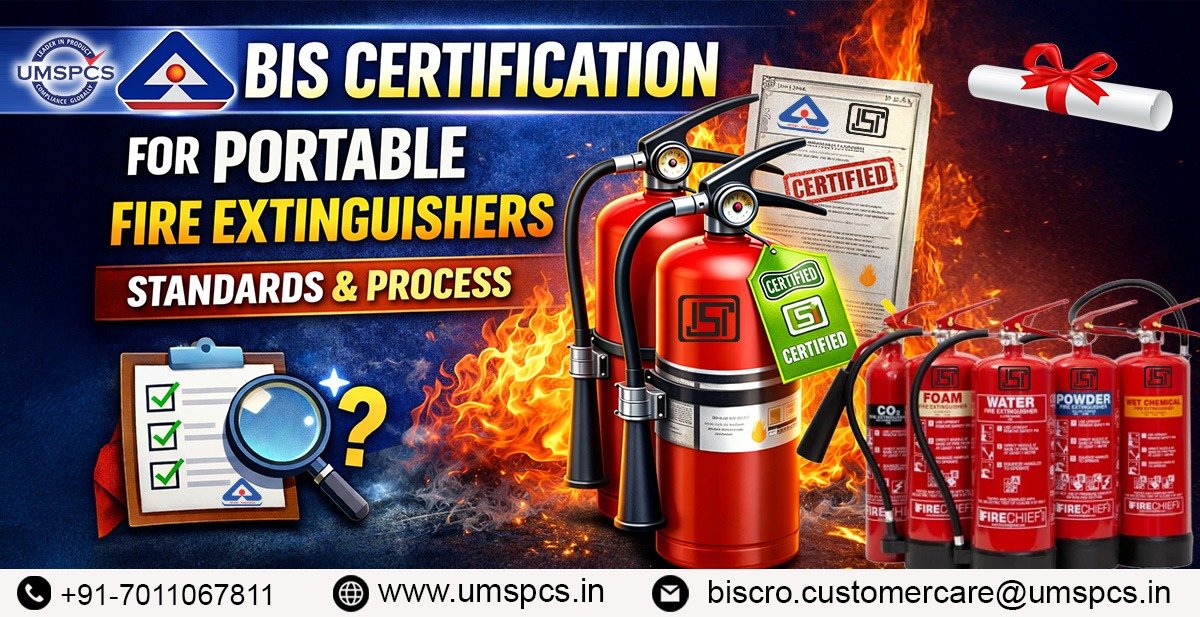
In India, public safety, industrial operations, and building plans all depend strongly on fire safety. Portable fire extinguishers that are portable are among the most important pieces of fire safety gear because they are made to put out fires early on and avoid significant harm to people or property. The Indian government ordered BIS certification for portable fire extinguishers due to their essential function in safety.
This blog offers a detailed, search easy to use guide on BIS certification for portable fire extinguishers in India. This includes necessary Indian standards, required certification, testing process, benefits, challenges, and also how an expert consultant can help importers and manufacturers in getting smooth compliance.
What are the Portable Fire Extinguishers?
We can use a portable fire extinguisher for small fires before it spreads. These portable fire extinguisher is often used in:
- Residential structures
- Offices and infrastructures
- Factories
- Hotels, hospitals, and institutions
- Automobiles, ships, and public transportation
Portable fire extinguishers are available in a variety based on the extinguishing agents that uses it:
- Fire extinguishers made of foam.
- Fire extinguishers with dried-out powder.
- Water Fire extinguisher for water only.
- Fire extinguishers of CO₂.
- Fire extinguishers of cleaning agents.
There are severals of portable fire extinguisher which is suitable for its own specific fire classes, like electrical fires or class A, B, C or D.
Is BIS certification is necessary for portable fire extinguishers
The Bureau of Indian Standards (BIS) is India’s national standards body that gives the ISI mark used for quality certification. It verifies its compliance with the essential Indian Standards (IS) and provides security and quality in India.
Importance of BIS Certification
Portable fire extinguishers with BIS certification are guaranteed to:
- Fulfil Indian performance and safety requirements
- Make use of high-quality components and materials
- Provide dependable rescue services
- Safe in use, storage, and handling.
Portable fire extinguishers can’t be sold, imported, produced, or distributed in India without the BIS certification as required by the Indian regulatory authorities. Products without certification are seen as dangerous and harmful.
Suitable Indian Standards (IS) for Portable Fire Extinguishers
A portable fire extinguisher comes under various Indian standards (IS) depending on its type and medium of burning. Among all of the. The most crucial step in BIS certification is finding suitable and correct standards.
IS 15683
Portable fire extinguisher for performance and construction standards.
It is the primary standard that establishes the general requirements for portable fire extinguishers in design, construction, performance, and testing.
IS 940
Fire extinguishers of water are specifically used for carrying out class A fires, which are only applicable for water based fire.
IS 10658
Fire extinguishers for a variety of carbon dioxide, which includes safety, discharge, and design of the cylinder under co2 portable fire extinguishers.
IS 13849
Dried-out powder fire extinguishers have class A, B, and C dry chemical powder. Which allows
Manufacturers and importers should must meet a specific Indian Standard (IS) before starting the BIS certification process for getting success.
Is the BIS certification is in demand for importers and foreigners?
Yes, both the Importers and foreign manufacturers should have the BIS certification.
- Local producers
- Manufacturers from other countries that export to India
- Brand owners and importers
Before exporting fire extinguishers to India, foreign manufacturers must receive BIS certification. If the BIS approval is not approved your product will get rejected at customs clearance, get seized, or fines will be imposed on you.
BIS Certification for Portable Fire Extinguishers
BIS Scheme-I (ISI Mark Certification Scheme) applies to portable fire extinguishers.
For this strategy, you have to follow the following:
- The product should successfully pass the laboratory test, which is only approved by the BIS.
- BIS officials inspect manufacturing facilities.
- Products that have been approved may bear the ISI mark.
In India, the ISI mark is a popular representation of safety and compliance.
BIS Certification Process for Portable Fire Extinguishers
Step 1: Find the correct Standard for your product
Choose the appropriate Indian Standard based on:
- Fire extinguisher type
- agent for extinguishing
- Application and capacity
Step 2: Testing of Products
A BIS-approved laboratory only tests the fire extinguisher for the factors in the following ways:
- Performance of extinguishing fires
- Time and range of discharge
- Leakage and resistance to pressure
- Durability and mechanical strength
- Resistance to corrosion
- Performance of the environment
Step 3: Submission of Complete Documentation
Manufacturers need to provide complete documentation, as follows:
- Application for BIS
- Product details
- Test results
- Details of the manufacturing process
- Plan for quality control
- Details of the equipment and the layout of the factory
Step 4: Factory Inspection
A factory inspection is carried out by BIS to confirm:
- Capacity for production
- Systems for quality control
- Internal testing facilities
- Manufacturing consistency
Step 5: Grant of BIS License
BIS authorises the use of the ISI mark on portable fire extinguishers following successful testing and inspection.
If the product passes the tests and inspection, only then do BIS officials use the ISI mark on a portable fire extinguisher.
Demands for Marking and Labelling of Products
Portable fire extinguishers are required to have the following markings to receive certification:
- ISI mark
- Applicable IS number
- Manufacturer’s name and address
- Type and capacity of extinguisher
- Date of manufacture
- Operating instructions
- Refilling and maintenance details
Your active license can get cancelled or suspended if your product has incorrect labelling.
After benefits of getting BIS certification for the portable fire extinguishe
Legal Market Access
Selling a fire extinguisher in India requires BIS certification to get into the Indian market.
Safety and Reliability checks
By making it sure that the product goes through intense tests to be certified.
Trust and Brand Credibility
Consumers feel more secure after seeing the ISI mark on the product.
Acceptance in Government and Industrial Projects
Fire extinguishers with BIS certification are necessary for:
- Tenders from the government
- For construction projects
- NOC approvals for fire
- Must meet the safety regulations for industrial safety
Advantages of gettinga BIS certification of a product:
Certification helps boost market value and brand reputation.
Common Challenges in BIS Certification
Manufacturers frequently deal with problems like:
- Selecting the wrong Indian Standard
- Failure in performance testing
- Delays in laboratory testing
- Incomplete documentation
- Non-conformities found in factory inspections
Certification might get delayed, or costs extra if these issues are not solved. As Certification helps in easy access to the market and brand reputation.
How UMS Product Compliance Services Helps
Professional support can significantly simplify the BIS certification process.
UMS Product Compliance Services (UMSPCS) provides end-to-end assistance for BIS certification of portable fire extinguishers, including:
- Identification of applicable IS standards
- Planning for compliance and gap analysis
- Coordination with laboratories approved by BIS
- Documentation preparation and submission
- Factory inspection and audit support
- Checking and renewal following certification
Manufacturers and importers may speed up approvals and prevent expensive compliance errors with the help of UMSPCS.
Requirements for After-Certification Compliance
Manufacturers are required to follow BIS certification as follows:
- Keep a consistent level of product quality
- Perform regular internal testing
- Allow BIS surveillance inspections
- Renew the BIS license on time
- Notify BIS of any modifications to the design or materials.
The BIS license may be cancelled or suspended for noncompliance.
In Conclusion
BIS certification ensures the product’s reliability, efficiency, and quality as it is an essential piece of safety equipment. A portable fire extinguisher should get BIS certification for legal and safety purposes.
Working with expert consultants like UMS product compliance services (UMSPCS) and sticking to the necessary Indian standards for proper certification. Manufacturers and importers get benefits with BIS certification, like getting market credibility for a longer time with brand reputation.
BIS certification for Portable fire extinguisher are life saving solution in such an unpredictable world, and it gives value to safety.
Frequently Asked Questions (FAQS)
1. Which Indian Standards (IS) relate to portable fire extinguishers?
A- A particular kind of extinguisher determines which IS standard is in effect. The most common requirements include:
IS 15683– Minimum standards for portable fire extinguishers
IS 940– Fire extinguishers of water are specifically used for carrying out class A fires, which are only applicable for water based fire.
IS 10658– Fire extinguishers for a variety of carbon dioxide, which includes safety, discharge, and design of the cylinder under co2 portable fire extinguishers.
IS 13849– Dried-out powder fire extinguishers have class A, B, and C dry chemical powder. Which allows
Manufacturers and importers should must meet a specific Indian Standard (IS) before starting the BIS certification process for getting success.
2. Do any of the foreign manufacturers and importers insist on BIS certification?
A- To sell portable fire extinguishers in the Indian market, importers, foreign manufacturers, and brand owners must wait to obtain BIS certification. Products may be declined at the border or may face legal proceedings if BIS approval is not received.
3. How can BIS certification be aided by UMS Product Compliance Services (UMSPCS)?
A- End-to-end BIS certification assistance is provided by UMS Product Compliance Services (UMSPCS), which includes:
- Finding the relevant IS standards
- Planning for product compliance
- Coordination with BIS-approved labs
- Documentation and submission of applications
- Help with factory inspections
- After certification support
We have a team of experts and professionals in this field who made this complex compliance journey a smooth one
4. What amount of time will need for fire extinguishers to receive BIS certification?
A- In general terms, the timeline is anywhere from three to six months, based on:
- Results of product testing
- Accuracy of documentation
- Preparedness for factory inspection
- Collaboration with laboratories authorised by BIS
If failures in tests or gaps in the documentation are discovered, delays could happen.
5. What are the typical causes of BIS certification denials?
A- Typical causes consist of:
- Choosing the incorrect Indian Standard
- Performance or pressure testing failure
- Inaccurate or lacking documentation
- Failure to comply with the factory inspection
- Inaccurate product labelling
- Expert advice reduces these risks.
❓ Ask a Question
Have any doubts? Fill the form below and our team will respond shortly.