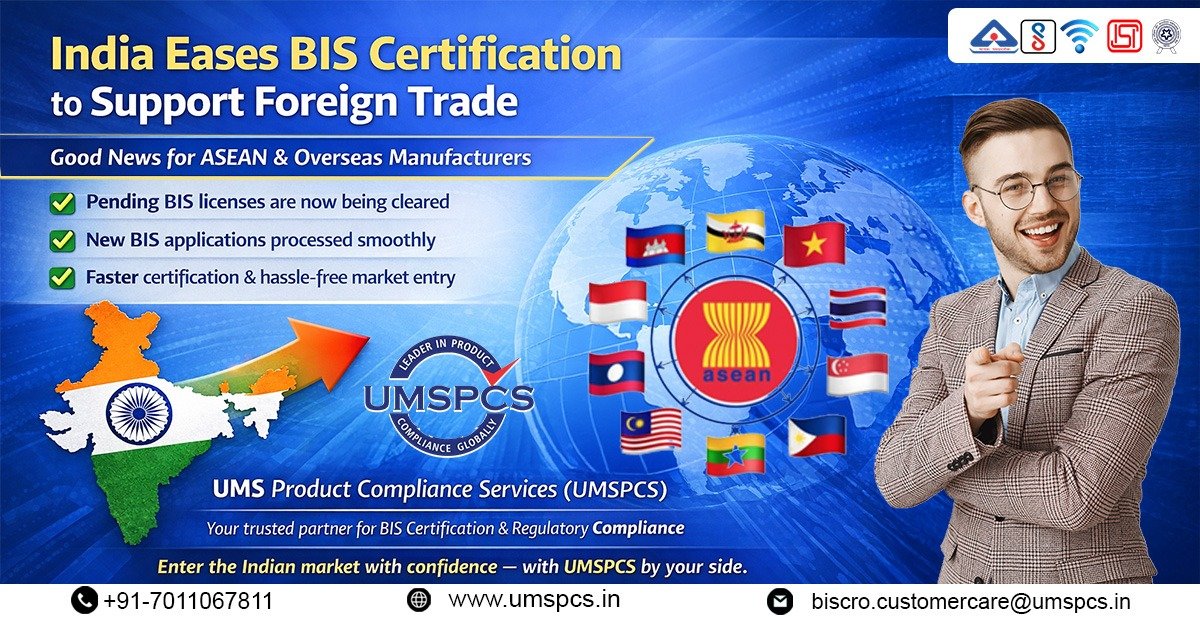
India rapidly formed its position among others, being the most desirable location for overall trade and manufacturing. The Indian market offers big business opportunities to ASEAN and foreign manufacturers because of its large consumer base, increasing demand for high-quality products, and proactive policies support for industrial growth. Therefore, BIS certification has always been challenging for foreign businesses looking to enter India.
India has been the most progressive over the past few years to make simpler BIS regulations and accelerating the certification process, which gives fast approvals without damaging product quality and safety. These changes improved trade relations, providing investment for the long term and supporting manufacturers from ASEAN countries and other foreign markets to enter the Indian market more consistently and quickly.
Understanding BIS and Its Role in the Indian Market
The Bureau of Indian Standards (BIS) is India’s national standards that gives the ISI mark used for quality certification. It verifies its compliance with the essential Indian Standards (IS) and provides security and quality in India.
BIS certification is necessary for many different products, such as:
- Electronic and electrical devices
- Appliances for the home
- Telecom and IT products
- Industrial devices and components
- Building supplies
- Products for consumers submitted under Quality Control Orders (QCOs)
BIS certification for Indian Market is required by law for foreign manufacturers. Products covered by the required certification can’t be sold, imported, or distributed in the Indian market without having a valid BIS approval. This is used to address compliance challenges for foreign manufacturers who are not used to Indian Standards, even after this structure protects consumers.
Difficulties Faced by ASEAN and Global Manufacturers Earlier
Before the recent simplification of BIS regulations foreign manufacturers faced several compliance-related challenges, including:
- lengthy and irregular certification schedules
- BIS-approved testing facilities are few in number.
- Requirements for repeated testing, even when international standards are met
- Application procedures that are complicated and require a lot of documents
- Delays in the auditing and inspection of factories
- Undefined interpretation of Indian standards.
These difficulties are the reason behind the postponed product launch, extra money, or limitation on market access, specifically among this rapid growing fields like consumer products, electronics, and electrical appliances.
BIS Restrictions Eased: Key Regulatory Reforms
The Indian government and BIS have carried out several kinds of legal reforms that simplify business dealings, promote international trade, and conform to international best practices. These modifications aim to make compliance easier while complying with rigid safety and quality requirements.
1. Streamlined Application and Certification Processes
BIS has improved its digital certification platform, allowing applications to be submitted, tracked, and managed online. Manufacturers are now able to enhance their market entry because of the significant decrease in paperwork, increased transparency, and decreased administrative delays.
2. Simplified Process under the FMCS Scheme
Clear guidelines and better coordination are the reasons behind the Foreign Manufacturing Scheme (FMCS), which is now easier to access by foreign manufacturers. Organised schedule and straight communication reduce the confusion by making it simpler for international businesses to easily access the certification in India.
3. BIS-approved Testing
Insufficient BIS-approved labs were one of the main issues in the past. BIS has reduced its testing timelines and backlogs by getting its own testing network. Certification approvals are now faster as a direct result of this improvement.
4. Reduced Redundancy in Testing (Selective Flexibility)
BIS has reduced the need for duplicate testing in some product categories where the products already meet globally accepted standards. Manufacturers have saved time and money because of this selective flexibility, even though complete allowances are not available.
5. Improved Coordination for Factory Inspections
An essential component of BIS certification is factory audits. Due to recent advancements in inspection arrangement and coordination, inspections can now be completed, and licenses can be issued more quickly.
Benefits for ASEAN Manufacturers
Primary producers of electronics, electrical appliances, and industrial products—a lot of which require BIS certification—include ASEAN countries like Vietnam, Thailand, Indonesia, Malaysia, and Singapore.
ASEAN manufacturers benefit in several ways from the simplification of BIS regulations:
- India’s quicker time-to-market
- Reduction in confusion and delays related to compliance
- Increased supply chain predictability
- Increased ability to compete with both domestic and international players
Along with promoting regional economic growth and supporting India’s Act East Policy, these reforms also improve trade relations between India and ASEAN.
Advantages for Global Manufacturers Beyond ASEAN
Manufacturers from across the world, such as the United States, Europe, China, Japan, South Korea, and other parts, may profit from BIS certification.
Key objectives are as follows:
- Decreased challenges to product entry due to regulations
- Increased trust in the compliance ecosystem in India
- Reduced extra costs and compliance risks
- Give support to long-term investments
- Uplifting the contract production and local manufacturing in India
These are the programs that complement national programs like Make in India, Ease of Doing Business, and Atmanirbhar Bharat, increasing India’s appeal to international manufacturers.
BIS Compliance Still Remains Mandatory
It is very necessary to understand that BIS certification requirements cannot be fully removed despite legal comfort. Manufacturers still need to make sure:
- submission to the relevant Indian Standards (IS)
- Correct ISI labelling and marking on the product and packaging
- Effective quality control systems and factory inspections
- Constant tracking and timely BIS license renewal
- The changes are not meant to remind manufacturers of their regulatory duties; rather, they concentrate on simplifying processes.
Penalties, limitations on imports, product seizures, or license cancellations or suspension are still possible outcomes of failing comply.
Importance of Professional Compliance Support
BIS certification is still technically challenging, even with simplified processes, especially for foreign manufacturers who are not used to Indian laws and regulations.
Experienced compliance consultants are essential in this situation.
UMS Product Compliance Services (UMSPCS) provides complete services, such as the following, to help ASEAN and international manufacturers obtain BIS certification more quickly and smoothly:
- Finding the necessary Quality Control Orders (QCOs) and BIS standards
- Complete support for FMCS and BIS certification
- Coordination with testing facilities approved by BIS
- Technical documentation preparation and submission
- Support for factory audits and inspections
- Tracking after certification, renewals, and compliance administration
Manufacturers can shorten approval times, prevent compliance mistakes, and concentrate on growing their markets rather than complicated regulations with the help of UMSPCS.
Strategic Opportunity for Global Market Expansion
India’s progress towards relaxing BIS regulations is part of a larger movement toward trade facilitation and regulatory advancement. India has created a warmer climate for foreign manufacturers by finding a balance between consumer protection and straightforward compliance.
This offers ASEAN and international businesses an important chance, which is as follows:
- The largest consumer market across the world.
- Minimises controlling issues and imposes products more quickly.
- Form strong manufacturing and distribution alliances
- Boost awareness of brands in India
Manufacturers will probably have a big competitive advantage if they carefully match their compliance tactics with the developing BIS framework.
In Conclusion
An important step towards success in India’s efforts to simplify business dealings and advance global trade is the relaxation of BIS regulations. Even though BIS certification is still required, ASEAN and international manufacturers now face much less competition because of simplified processes, increased testing capacity, and stricter regulations.
Foreign manufacturers are able to effectively manage India’s compliance landscape and achieve more quickly and more effectively by combining regulatory awareness with professional assistance from trustworthy collaborators like UMS Product Compliance Services.
Effective compliance is now a strategic requirement in today’s highly competitive global marketplace. Global manufacturers now have more opportunities to enter and grow in the Indian market due to India’s developing BIS framework.
Frequently Asked Questions (FAQs)
Q1. Does BIS accept reports from foreign tests?
A- BIS permits selective liberty in certain product categories where worldwide accepted standards are already achieved. But in most situations, lab testing that has been approved by BIS is still necessary. Generally speaking, complete allowances are not given.
Q2. Do BIS relaxations last a lifetime?
A- India’s turn toward facilitating trade and a simpler way of doing business is reflected in the current relaxations. However, as BIS regulations change with new Quality Control Orders(QCOs) and updated standards, manufacturers need to keep up.
Q3. What does BIS’s FMCS Scheme look like?
A- For the purpose of importing regulated products to India, foreign manufacturers can obtain BIS certification through the Foreign Manufacturers Certification Scheme (FMCS). FMCS is now more predictable, transparent, and effective for foreign applicants because of recent changes.
Q4. Do BIS relaxations last a lifetime?
A- India’s shift toward facilitating trade and simplifying doing business is reflected in the current relaxations. However, as BIS regulations change with new QCOs and updated standards, manufacturers need to keep up.
❓ Ask a Question
Have any doubts? Fill the form below and our team will respond shortly.