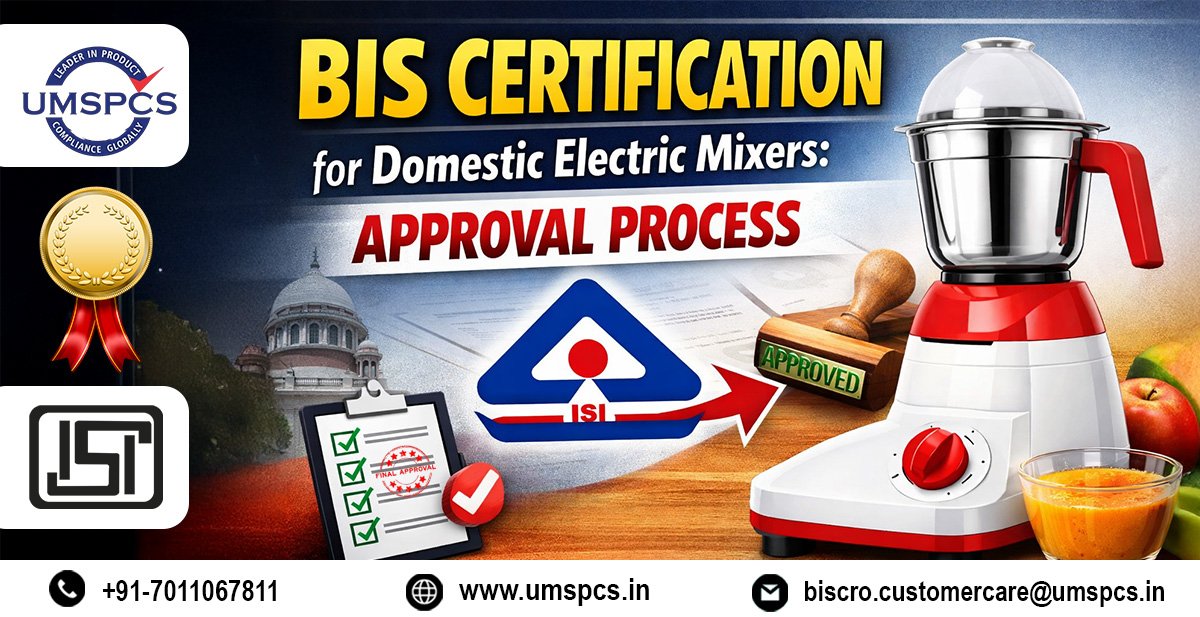
The quality, safety, and compliance are becoming critical in India’s fast-growing consumer market, not primarily for brands but also for consumers who have to use electrical appliances for daily tasks. The household electric food mixer (which includes grinders, blenders, and combined mixer units) is one such commonly used appliance in Indian kitchens. However, companies should understand the Bureau of Indian Standards (BIS) certification standards that are necessary for these products before they can be produced, sold, imported, or distributed in India.
Everything that you require to know about BIS certification for domestic electric food mixers is covered in this blog, including legal requirements, standards (like IS 4250), testing specifications, the advantages of certification, and how businesses like UMS Product Compliance Services can help you complete the compliance process.
What is BIS?
The Bureau of Indian Standards (BIS) is India’s national standards that gives the ISI mark used for quality certification. It verifies its compliance with the essential Indian Standards (IS) and provides security and quality in India.
Domestic Electric Food Mixers — What Does BIS Cover?
Most of the electric food mixers used at home are:
- Liquidisers (for smooth purées and blending)
- Grinders (both wet and dry)
- Mixer units combined with a variety of attachments
The Indian Standard IS 4250 regulates these products under Indian regulations. The design, construction, performance, and safety requirements stated in this standard must be fulfilled in order for a license to be granted.
Main Objective of IS 4250 Standard
- Electrical safety includes protection against electrical shock.
- Electrical ratings such as voltage, current, and wattage are all covered under the Indian standard.
- High voltage limits and Insulation struggle.
- Protection against overheating and Mechanical dangers.
- Stability of the appliance while in use.
- Earthing and leakage current standards.
- Material quality and construction of jars, blades, and bodies
- Performance and durability under regular household usage
To put it simply, just to confirm that your food mixer is safe, has excellent quality and is designed for daily use if it meets the IS 4250
Mandatory BIS Certification — What It Means
The Indian government required BIS certification for kitchen appliances QCO in 2018 for electric food mixers, which came into force from May 1, 2019, in the Indian market.
This indicates:
- Domestic electric food mixers cannot be sold, imported, manufactured, distributed, or kept in India without the BIS certification.
- Failure to comply can result in penalties, product seizure, and possibly legal action.
- This applies to both foreign businesses importing goods into India and Indian manufacturers.
Testing & Compliance Requirements
Your product must be tested in a BIS-approved laboratory to obtain BIS certification under Scheme-I (Conformity Assessment). A variety of factors are tested by the product, usually including:
- Electric shock protection
- Stability, mechanical safety, and durability
- High voltage performance
- Insulation strength and resistance
- Reliability of switching and control functions
- Earthing continuity
- Protection against temperature rise and overload
After completing laboratory testing, manufacturers are required to submit a detailed request to BIS, complete with product samples, factory inspection reports, and supporting documentation. BIS grants permission to use the ISI mark on the product and its associated packaging after testing and documentation compliance are completed.
The ISI mark on your product is a sign of its excellent quality and product safety in India, which ensures the consumer that it is safe to use.
Benefits of BIS Certification?
1. Legal Market Access
BIS certification is required by law, not simply something to have. Without it, products may be seized by market regulators, blocked at ports, or taken off of e-commerce listings.
2. Trust among buyers & Brand Reputation
Customers immediately find that your product is safe, has excellent quality, and dependable when they see the ISI/BIS mark, which is essential in a competitive marketplace. They trust your product.
3. Minimises Product liability
Products that have been certified have to pass strict testing procedures. which reduces the possibility of dangers from electricity, overheating, or mechanical malfunctions to the consumers.
4. Competitive Edge
In terms of both durability and safety, products that conform to BIS standards often perform better than uncertified products, giving them an advantage in shops and online marketplaces.
The Certification Process — Step by Step
Step 1: Find the correct Standard
Check that if your product, like the mixer model, meets the necessary IS 4250 and also keep an eye out for the updates on specific standards (IS 4350:2025).
Step 2: Product Testing
Get your product tested at a test lab approved by BIS. The tests measure performance, mechanical quality, insulation, and electrical safety. The scope of testing requirements may be expanded by recent changes to IS standards.
Step 3: Documentation
Collect all necessary documents:
- Details of the factory and quality control procedures
- Test results
- Technical details
- Details of the manufacturer
- Product images and samples
Step 4: Submission & Inspection of the factory
Use the BIS portal or BIS-approved officials for submitting your application. To ensure consistency and quality systems, BIS will inspect factories.
Step 5: Certification Issuance
A license to operate the ISI mark is granted by BIS upon approval. India is now able to import and sell the product legally.
Challenges Manufacturers Face
Despite the clear definition of the BIS process, many manufacturers face obstacles:
- Locating approved testing facilities
- Recognising updated standards (such as IS 4250 revisions)
- Creating documentation in rigid formats
- Getting through factory audits
- Fulfilling packaging and labelling specifications
- Adapting to modifications in regulatory standards
This is where expert advice can be very helpful.
How UMS Product Certification Services Helps
Working with experienced advisors can help manufacturers and importers get through the BIS certification web more easily.
Under IS standards, UMS Product Compliance Services (UMSPCS) is experienced in guiding businesses in achieving compliance with regulations for their electrical products, including home electric food mixers. They provide services like:
- Early evaluation of the product in relation to relevant BIS ISI standards
- Conducting testing with recognised laboratories
- BIS application preparation and submission
- Support with compliance inspections and documentation
- Guideline of Labeling and packaging
- After certification support and renewal
Businesses can shorten certification timelines and stay clear of expensive re-submissions or compliance problems with the professional help of UMSPCS.
The professional designation assistance serves as a strategic investment in your brand’s success, regardless of whether you are an established player importing goods for the Indian market or a startup introducing your first kitchen appliance.
Compliance Is an Ongoing Responsibility
Manufacturers must continue to make sure that:
- Production items constantly match the certified sample after receiving BIS certification.
- Maintaining quality checks.
- Updating documentation to reflect design or component changes.
- Timely submission of renewals.
Failing to maintain compliance might place the BIS license in danger and result in regulatory actions or market bans.
In Conclusion
BIS certification for domestic electric food mixers is essential in a market that values quality and safety. This is not only because it is required, but it also improves consumer trust, protects your company from legal risks, and improves brand reputation.
Knowledge of the standards, such as IS 4250 and continuous updates, and collaborating with a trustworthy certification service, such as UMS Product Compliance Services (UMSPCS), can transform an extensive compliance journey into a systematic, controllable procedure.
Take BIS certification seriously if you want to sell, export, or distribute food mixers in India. It’s more than just a license, but it’s a dedication to quality that is attractive to both customers and regulators.
Frequently Asked Question( FAQS)
Q1. Does India’s domestic electric food mixer industry require BIS certification?
A- Yes, according to the Quality Control Order (QCO) issued by the Indian government, BIS certification is needed for domestic electric food mixers. Electric food mixers can’t get produced, imported, sold, or distributed in India without an active BIS ISI certification of May 1, 2019.
Q2. For electric food mixers, which Indian Standard is applicable?
A- IS 4250 covers electric food mixers used at home. For household use, this standard sets out requirements for electrical safety, insulation, mechanical strength, performance, temperature rise, earthing, and durability.
Q3. Do imported electric mixers qualify for BIS certification?
A- Indeed, before exporting electric food mixers to India, foreign manufacturers must also receive BIS certification. An Authorised Indian Representative must be suggested by them.
Q4. Does every mixer model need to be certified by BIS?
A- Indeed. Unless covered by an authorised series of guidelines, every model with unique electrical ratings, designs, or specifications requires its own BIS approval.
Q5. What is the time period of a BIS license to expire?
A- Generally granted for one to two years, after that BIS license needs to be renewed before any further usage. Throughout the license period, regular compliance and oversight inspections are required.
❓ Ask a Question
Have any doubts? Fill the form below and our team will respond shortly.