India has one of the biggest textile manufacturers across the world, which gives a great chance for employment, exports, and manufacturing capacity. Cotton duck fabric is essential for this huge ecosystem because of its strength, long lifespan, and extreme industrial use. However, BIS certification for cotton duck is now known as an essential requirement for producers, importers, and suppliers who operate in the Indian market, as quality standards become more demanding and government control grows.
This blog includes in-depth knowledge of BIS certification for cotton duck, such as the certification process, compliance issues, and how expert consultants like UMS Product Compliance Services (UMSPCS) help businesses in getting smooth certification.
What is Cotton Duck Fabric?
Cotton duck is a bulky, basic-woven cotton fabric with a high tear strength and strong structure. Cotton duck is prone to wear and tear due to the fact that it is woven using dense yarns in a compact pattern, unlike regular cotton fabrics.
Normal Uses for Cotton Duck:
- Military and commercial tents
- Covers and tarps
- Bags of canvas and tool kits.
- Furnishings and textiles
- Protection from industrial textiles.
- Utility and outdoor goods
Cotton duck needs to set quality and performance standards because it is used in heavy-duty and life-threatening uses, thus governance and certification are crucial.
Role of BIS in Textile Product Regulation
Working under the BIS Act of 2016 The Bureau of Indian Standards (BIS) is India’s national standards that gives the ISI mark used for quality certification. BIS includes:
- Identify the Indian Standards (IS)
- Keep the safety and quality of products at point
- Product certification using conformity assessment programs
- Avoid the spread of lower-quality goods
The main objective is to make sure that textiles confirm a good level of quality before being sold to consumers or industrial buyers. BIS establishes technical requirements related to fabric weave, thickness, tear resistance, durability, and performance.
Applicable BIS Standard for Cotton Duck
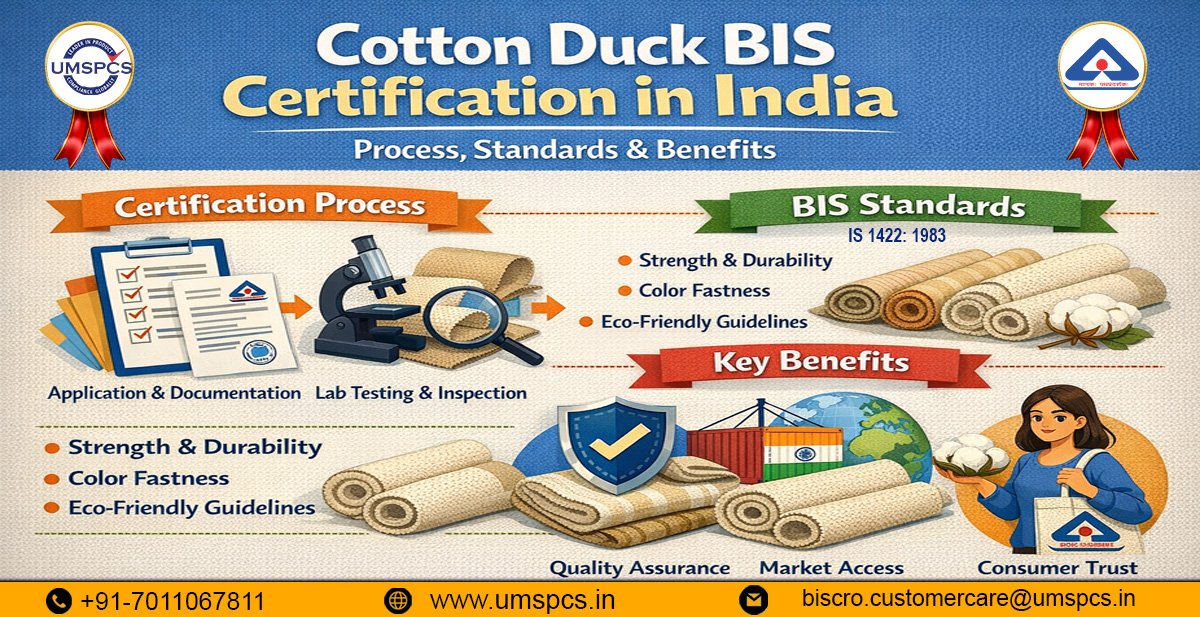
The IS 1422:1983 standard for cotton duck. This Indian Standard spells out specifications for:
- Weave and fabric construction
- Yarn composition and quality
- mass per square meter
- Dimensional tolerance and width
- Physical performance and strength
Cotton duck fabric that conforms with IS 1422 has been confirmed to be compatible with the purpose it was created for and to meet similar quality standards throughout the market.
Is BIS Certification Mandatory for Cotton Duck?
The expected use of the cotton duck fabric defines the BIS certification requirements:
- It comes under any Quality Control Order (QCO)—
- Requirements for buyers or tenders, especially from the government and institutional buyers.
BIS certification becomes mandatory when:
- When cotton duck arrives in restricted or vulnerable applications, BIS certification is required.
- Organizations in the public sector or government departments require BIS-certified materials.
- Proof of conformity to Indian Standards is required by import regulations.
Obtaining BIS certification offers considerable commercial benefits and increases market acceptance, even in situations where certification is not specifically required.
Why BIS Certification is Important for Cotton Duck Manufacturers
1. Legal Market Access
Products can be sold legally into the Indian market without fear of penalties or seizure because of BIS certification, which confirms to Indian laws.
2. Quality Assurance
By confirming that the fabric satisfies prescribed technical standards, certification reduces the possibility of rejection and quality conflicts.
3. Trust and Brand Credibility
Buyers, governmental organizations, and institutional clients all have confidence in the BIS Standard Mark.
4. Competitive Advantage
In contracts linked to exports, massive purchases and offers for certified products are given priority.
5. Import Clearance
BIS compliance helps importers avoid non-compliance notices, detentions, and delays at customs.
BIS Certification Process for Cotton Duck
Correct technical knowledge and coordination of regulations are essential for the structured, lengthy process of obtaining BIS certification.
Step 1: Identification of Applicable Standard
Verifying IS 1422:1983, along with determining the relevant certification scheme according to product usage and manufacturing location, are the first steps.
Step 2: Application Submission
Manufacturers and importers are required to submit an online application with the entire product and factory details via the BIS portal.
Step 3: Documentation Preparation
Important documents consist of:
- Technical details and product specifications
- Flow of the manufacturing process
- Procedures for testing and quality control
- Details of the raw materials
- Information about equipment and the layout of the factory
Step 4: Sample Testing
Product samples have been submitted to laboratories approved by BIS for testing in line with IS 1422 guidelines.
Step 5: Factory Inspection
A factory inspection may be performed by BIS officials to confirm:
- Capacity for manufacturing
- Systems for quality assurance
- Internal testing facilities
- Production consistency
Step 6: Grant of BIS Licence
BIS certification gives a license that allows the manufacturer to use the BIS standard mark on products of cotton duck through successful inspection and testing.
Step 7: Observation and Renewal
BIS certification requires repeated testing, inspection, and a periodic function renewal with the objective of guaranteeing continuous compliance.
Common Challenges in BIS Certification for Cotton Duck
Without clearly stated guidelines, businesses often face real-world difficulties like:
- Misunderstanding of textile requirements
- Laboratory testing delays
- Inaccurate or lacking documentation
- Inspection of the factory revealed nonconformities
- Challenges in coordinating with BIS authorities
If not handled properly, these difficulties have the potential to greatly delay approval processes and raise compliance expenses.
How Professional BIS Consultants Add Value
Considering the complexity of the technical and legal aspects, collaborating with knowledgeable compliance consultants helps guarantee:
- Quicker approval processes
- Decreased chance of rejection
- Coordination of testing and appropriate documentation
- Efficient management of surveillance and audits
UMS Product Compliance Services (UMSPCS): Your BIS Certification Partner
Cotton duck and other textile and industrial products can receive complete BIS certification support from UMS Product Compliance Services (UMSPCS), a respected compliance consultancy.
UMSPCS supports importers and manufacturers at every step of the certification process through its broad regulatory knowledge and practical experience.
How UMSPCS Supports BIS Certification for Cotton Duck
BIS Certification for Cotton Duck Standards is Supported by UMSPCS:
- Identification and Application Assessment
- Detailed Documentation Preparation
- Working together with Testing Laboratories approved by BIS
- Preparing Factory Inspections and Assisting with Application Inspection and
- Regulatory Coordination
- Review after Certification and Help with Renewal
By avoiding unnecessary postponements and regulatory risks, UMSPCS promises that clients meet compliance effectively.
UMSPCS offers customized services that are in line with BIS requirements, regardless of whether you are a domestic manufacturer, a foreign exporter, or an importer entering the Indian market.
You can reach us at UMSPCS. is the official website.
Why Choose UMSPCS for BIS Certification?
- Great familiarity with Indian textile standards
- a track record of success in BIS and product compliance
- skilled regulatory specialists
- Schedules and procedures that are transparent
- Long-term assistance with compliance
Businesses are able to focus on growth and production by working with UMSPCS, as experts handle the complexities of regulations on your behalf.
Conclusion
Cotton Duck BIS certification is for long-term investment in product quality, market credits, and business sustainability, and not just a legal requirement, as it has many benefits. Manufacturers and importers must be sure of the immediate acceptance of relevant BIS standards as India continues to boost quality enforcement for all textile products.
Although the certification process can be challenging, it can be made simple, effective, and reliable with the help of experts like UMS Product Compliance Services (UMSPCS).
Getting the BIS certification with the right compliance partner will assist you in achieving long-term success in a highly competitive and quality-conscious market if you plan to produce, import, or supply cotton duck fabric in India.
❓ Ask a Question
Have any doubts? Fill the form below and our team will respond shortly.