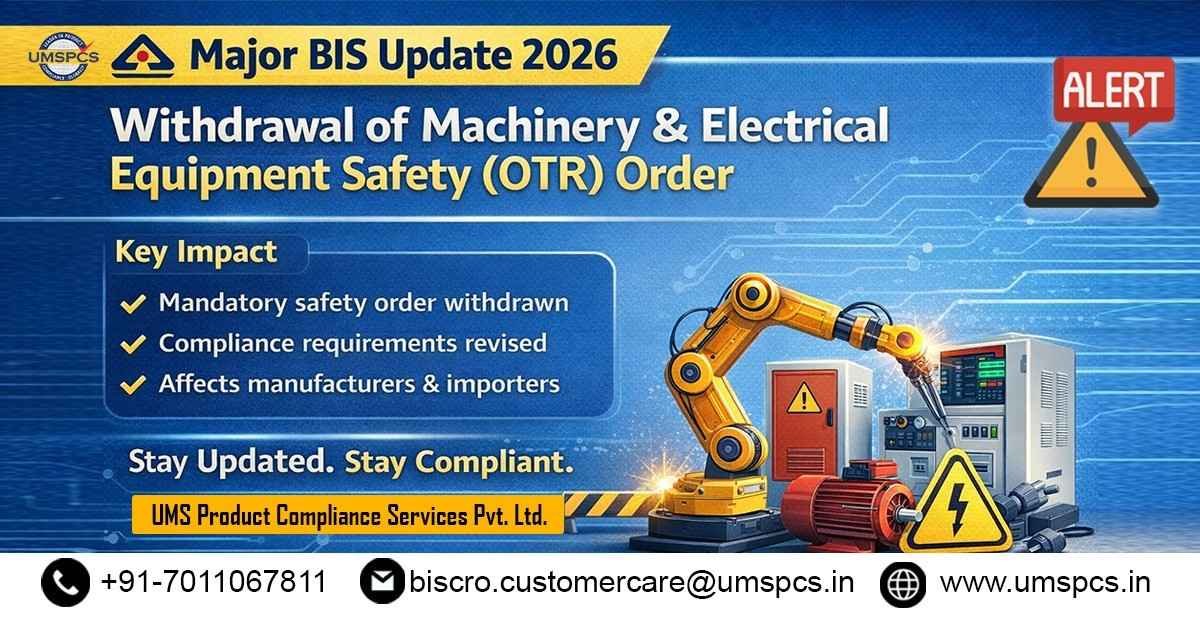
The Indian Government has legally cancelled the machinery and electrical equipment safety (Omnibus Technical Regulation) order, 2024, also referred to as the OTR order, with immediate effect. It represents an essential regulatory development. The Ministry of Heavy Industries’ announcement on January 14, 2026, has brought considerable relief and new queries for manufacturers, importers, and all other parties involved in machinery and electrical equipment compliance in India.
Under the Bureau of Indian Standards (BIS) Act of 2016, the omnibus technical regulation (OTR) order’s withdrawal reflects an important shift in India’s approach to product safety and standards. Businesses that were preparing for compulsory OTR compliance now have to reconsider their future compliance planning and regulatory duty.
UMS product compliance services pvt ltd (UMSPCS) provides you with this detailed blog about what the OTR order was, why it was withdrawn, its immediate effect, and what importers and manufacturers should do next.
Background: What Was the Machinery & Electrical Equipment Safety (OTR) Order, 2024?
The Ministry of Heavy Industries introduced the Machinery and Electrical Equipment Safety (omnibus technical regulation) order, 2024, to establish a standard structure for technical compliance and safety for machinery and electrical equipment distributed in India.
Demanding compliance with specific Indian standards, the OTR order was intended to govern a wide range of products, including electrical equipment, assemblies, and industrial machinery. Section 16 of the BIS Act 2016 grants the central government the power to enforce technical regulations in favour of the public.
The OTR order’s main objectives were:
- Better equipment safety for electrical and machinery.
- Avoid selling unsafe and dangerous products.
- Match Indian laws with worldwide safety standards.
- Instead of having several separate requirements, create a single “Umbrella regulation”.
Fortunately, since its introduction, the industry has spoken out against the OTR order due to its broad coverage and difficult implementation structure.
Official BIS Update 2026: OTR Order Withdrawn
The central government has instantly withdrawn the earlier notification concerning the OTR order, 2024. As per the Gazette of India Extraordinary notification posted on January 14, 2026:
- The order has been cancelled as noted in the withdrawal notification under section 16 of the BIS Act of 2016.
- The decision was taken by keeping public interest in mind.
- There is no transition period as the revocation goes into effect instantly.
Therefore, the 2024 machinery and electrical equipment safety (OTR) is no longer in force.
Why Was the OTR Order Withdrawn?
The decision is likely driven by a variety of practical and legal factors, even if the notification does not fail to offer specific details.
In conflict with current BIS regulations
Several electrical and machinery products are already regulated by:
- Compulsory registration scheme, or CRS.
- Quality control ordered(QCOS).
Specific to a product, confusion and a burden of regulation might come from the OTR order’s possibly creating duplicate compliance requirements.
Implementation difficulties:
In response to the regulations’ “omnibus” format, a wide variety of machinery categories were merged into a single structure. This developed:
- Complicated procedure of testing.
- Standard interpretation is tough.
- Differences in enforcement among sectors.
Industry concerns:
Concerns have been raised by importers and manufacturers about:
- High costs related to compliance.
- Lack of facilities for testing.
- Timeline which remain unclear.
- Insufficient clarity on product coverage and scope.
A systematic regulatory approach is required:
The withdrawal signifies that instead of providing a single, broad instruction, the government may support sector-or specific product guidelines.
Immediate Impact of the OTR Withdrawal
OTR Compliance is No Longer needed
The Machinery and Electrical Equipment Safety (OTR) Order, 2024, standards are no longer useful for businesses.
It could be done to stop any certification, documentation, or inspection procedure performed strictly for OTR compliance.
Present BIS Certification do not change.
This withdrawal had no impact on:
- Compulsory BIS Certification.
- Electronic and IT products for CRS registration.
- Active quality control order under other ministries.
Manufacturers and importers need to conform to all current safety and BIS regulations.
Importers continue under existing regulations.
OTR-related inspection will not be executed by customs officers. But importers still have to perform by:
- BIS Act of 2016
- Applicable QCOs.
- Requirements for the legal measurements.
What Happens Next for Machinery and Electrical Equipment Regulation?
The deregulation is not suggested by the OTR order’s withdrawal. Instead, it indicates a change in their approach to enforcement.
Potential Future Growth
Specific product QCO’S introduction
The government may issue different quality control orders for specific machinery categories instead of an omnibus regulation. Such as:
- Industrial equipment.
- Construction machines.
- Control tools and electrical panels.
- Heavy engineering products.
Improving the current BIS Program
BIS may expand its role under:
- Certification by the ISI Mark.
- Rules for high-risk machine safety.
- Plans for sector-specific compliance.
More effective Industry Tips:
It is believed that future regulations will include:
- Enhanced participation of interested parties.
- Execution processes are more detailed.
- Well-defined process of testing and certification.
What Should Manufacturers and Importers Do Now?
Businesses are now allowed to adjust their compliance strategy because of the OTR order’s withdrawal.
Check the status of product compliance.
Find out if your product has been secured by:
- Present BIS certification schemes.
- Any present or upcoming QCO CRS registration.
- Avoid participating in OTR-specific activities.
Discontinue OTR-Specific Activities
It is likely to stop any processes that have begun only for OTR compliance.
Keep an eye out for new notifications.
Have a close eye on updates from:
- Department for Promotion of Industry and Internal Trade (DPIIT).
- The Bureau of Indian Standards
- Ministry of Heavy Industries.
Get expert guidance on compliance.
Concern might come from changes in rules. Expert guidance promises continuous compliance without affecting processes.
How UMSPCS guides you by making changes to the rules
A trustworthy BIS certification and product compliance consultancy in India, UMS product compliance services (UMSPCS), supports importers and manufacturers in many different kinds of industries.
Examples of the services we provide:
- BIS ISI Certification.
- Registering CRS.
- Guide for QCO compliance.
- Support for importers and for entering the market.
- Compliance with electrical and machinery equipment.
UMSPCS helps businesses with the OTR orders withdrawal:
- Recognise your current regulatory duties.
- Avoid gaps in compliance.
- Get yourself ready for the upcoming QCO and BIS updates.
Conclusion
One of the most crucial BIS-related changes of 2026 is the cancellation of the machinery and electrical equipment safety (OTR) order, 2024. Strict conformity to current BIS standards and quality control orders remains essential, yet it reduces immediate compliance pressure.
BIS certification Manufacturers and importers need to be proactive, educated, and prepared for alterations in regulation. Businesses are capable of handling regulatory changes while preserving market access and compliance with the guidance of a highly qualified member of UMSPCS.
Frequently Asked Questions (FAQS)
Q.1 What is the machinery and electrical equipment safety (OTR) 2024, order?
A- In line with section 16 of the BIS Act, 2016, the ministry of heavy industries passed the machinery and electrical equipment safety (Omnibus technical regulation) order, 2024. The intention was to build a uniform structure for technical compliance and safety for machinery and electrical equipment distributed in India.
Q.2 Has the OTR order been actually withdrawn?
A- YES. In an article circulated in gazette on january 14,2026, the government of India officially withdrawn the machinery and electrical equipment safety (OTR) order, 2024. The withdrawal occur effect straight away.
Q.3 What date does the OTR order come to and end?
A- The ministry of heavy industries gave the withdrawal notification on january 14,2026, which declared the expiration of the OTR order’s validity.
Q.3 What led the OTR order to be withdrawn?
A- The withdrawal is thought by most to be a result of multiple BIS regulations, implementation confusion, industry ability concerns, and the need for a more specific product legal approach, although the notification does not fails to give specific reasons.
Q.4 Do manufacturers still have to comply with the OTR?
A- NO. Manufacturers are no longer required to comply with any of the OTR order standards. It could be done to put an end on all OTR specific compliance actions.
Q.5 Will the government replace the OTR Order with a new regulation?
A- Instead of passing a single omnibus regulation or the government is likely to enforce quality control order that are either sector-specific or product-specific. Better clarity as well as simpler implementation have been made by this approval.
Q.6 Should companies cease all machinery safety compliance efforts?
A- NO, businesses should only stop actions that have been established just to keep up with OTR regulation. All other compliance requirements with respect to safety, quality, and BIS must stay in place.
Q.7 What measures should importers and manufacturers implement after the PTR withdrawal?
A- To stay on track, manufacturers and importer should must evaluate their current compliance status, ensures that current BIS regulation are complied within, keep an eye out for the upcoming notifications and ask for guidance from experts.
❓ Ask a Question
Have any doubts? Fill the form below and our team will respond shortly.