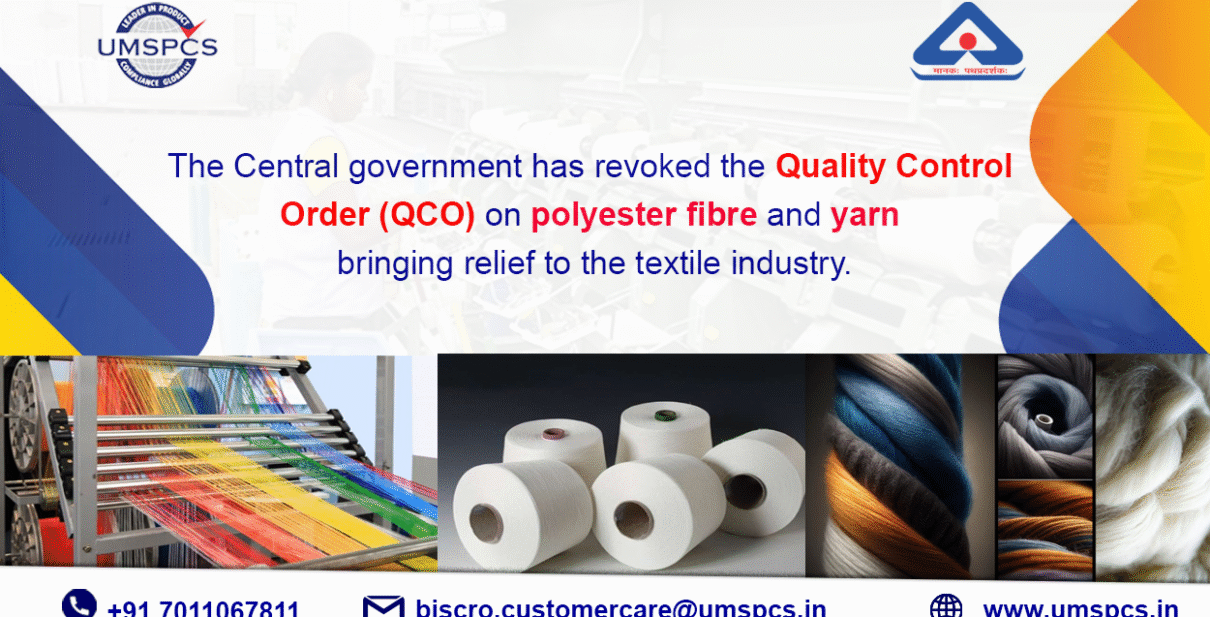
On 12 November 2025, the Ministry of Chemicals and Fertilizers, Government of India, issued multiple notifications withdrawing several Bureau of Indian Standards (BIS) Quality Control Orders (QCOs).
These withdrawals mark a significant regulatory shift in India’s chemical and polymer industry, removing the mandatory BIS certification requirement for numerous key materials that had long been under regulatory scrutiny.
This decision—taken “in the public interest” after consultation with the Bureau of Indian Standards—signals a move towards greater trade flexibility, reduced compliance burden, and market-driven quality assurance.
Products Affected by the Withdrawal
The following products are no longer subject to mandatory BIS certification under the withdrawn QCOs:
Terephthalic Acid (TPA)
Ethylene Glycol (EG)
100% Polyester Spun Yarn (Grey & White)
Polyester Industrial Yarn (IDY)
Polyester Staple Fibre (PSF)
Polyester Continuous Filament Fully Drawn Yarn (FDY)
Polyester Partially Oriented Yarn (POY)
Polyethylene Material for Moulding and Extrusion
Acrylonitrile Butadiene Styrene (ABS)
Polypropylene (PP) Material for Moulding and Extrusion
Polyvinyl Chloride (PVC) Homopolymers
Ethylene Vinyl Acetate (EVA) Copolymers
Polyurethanes
Polycarbonate (PC)
These materials are widely used in the textile, packaging, automotive, construction, and electronics sectors—making the withdrawal of BIS QCOs particularly impactful across industries.
Background: Why BIS QCOs Were Introduced
The Quality Control Orders (QCOs) under the Bureau of Indian Standards Act were designed to:
Ensure uniform quality across imported and domestically produced goods,
Prevent substandard imports,
Promote consumer safety, and
Strengthen India’s manufacturing competitiveness under the Make in India initiative.
However, over the years, industry stakeholders—especially chemical manufacturers, importers, and associations—raised concerns regarding:
Delays in BIS certification,
Limited testing infrastructure,
Complex compliance procedures, and
Impact on raw material supply chains.
The issue of QCO applicability to basic industrial raw materials (such as polymers) has been a key discussion point between industry and regulators for a long time.
Key Reasons Behind the Withdrawal
The government’s decision to rescind the QCOs can be attributed to several interconnected factors:
1. Public Interest Consideration
The official notifications explicitly cite public interest as the rationale. This includes ensuring material availability, minimizing supply chain disruptions, and supporting downstream industries.
2. Ease of Doing Business
By removing mandatory BIS certification for raw materials, the government aligns with its broader goal of reducing regulatory friction and improving ease of doing business in India.
3. Support for MSMEs and Importers
Small and medium manufacturers often struggled to obtain BIS licenses due to high testing costs and procedural delays. The withdrawal helps MSMEs access materials more easily and competitively.
4. Global Trade Alignment
The move enhances India’s trade alignment with international standards and reduces technical barriers to imports, especially from major chemical-producing countries such as China, South Korea, and Singapore.
5. Feedback from Industry Associations
Over the past year, multiple industry bodies and chemical federations had been in dialogue with the Department of Chemicals and Petrochemicals (DCPC) and BIS, emphasizing the operational difficulties arising from QCO implementation.
The government’s decision reflects responsiveness to these long-standing industry concerns.
Key Implications for the Industry
1. Regulatory Relief
Manufacturers, importers, and distributors of the affected materials no longer need to obtain BIS certification or affix ISI marks. This reduces the administrative burden, certification fees, and audit requirements previously mandated under QCOs.
2. Ease of Trade and Supply Chain Flexibility
With QCO restrictions lifted, imports of these polymers and chemicals can resume freely from global suppliers. This will likely result in:
Faster sourcing cycles,
Reduced costs, and
Improved material availability in domestic markets.
3. Market Competitiveness
The absence of certification barriers will intensify competition, particularly from international producers who can now access the Indian market without BIS compliance hurdles.
Domestic manufacturers may need to enhance product quality, pricing, and innovation to maintain competitiveness.
4. Shift to Voluntary Quality Assurance
While mandatory BIS certification is no longer required, buyers and large OEMs may still demand quality assurance through:
Voluntary BIS certification,
ISO standards, or
Third-party lab testing.
Thus, quality responsibility now shifts from regulators to industry participants.
5. Impact on Downstream Industries
Downstream sectors such as packaging, textiles, automotive components, and consumer goods will likely benefit from:
Greater material choice,
Reduced input costs, and
More stable production timelines.
However, the onus of quality control will rest on procurement policies and supplier contracts.
Industry Perspective: A Balanced Outcome
The withdrawal of BIS QCOs represents a balanced approach—offering relief while encouraging self-regulation.
Industry experts suggest that while regulatory compliance becomes simpler, maintaining consistent product quality will be essential to:
Protect consumer trust,
Prevent counterfeit or substandard imports, and
Sustain India’s manufacturing credibility.
Many manufacturers are expected to continue voluntary adherence to BIS or equivalent standards as a competitive differentiator.
Global and Domestic Trade Outlook
Imports:
Countries such as China, South Korea, and Taiwan, major exporters of polymer materials, are expected to see increased demand from Indian buyers.
Domestic Manufacturers:
Indian producers may experience short-term competitive pressure, but long-term, the shift could promote innovation, cost efficiency, and exports through greater global alignment.
Regulatory Landscape:
While BIS QCOs have been withdrawn for these materials, the government may review other chemical categories under similar frameworks in the coming months—balancing quality control with trade facilitation.
What Industry Stakeholders Should Do Next
Review Product Portfolios:
Identify which materials in your supply chain are affected by the QCO withdrawal.Update Compliance Documentation:
Remove references to mandatory BIS certification but maintain internal quality records.Engage with Suppliers:
Ensure your sourcing partners maintain consistent quality—even without BIS oversight.Voluntary Certification:
Consider continuing BIS or ISO certification voluntarily for customer assurance and export readiness.Stay Updated:
Monitor future BIS notifications or reintroductions of QCOs in other product segments.
Conclusion
The withdrawal of BIS Quality Control Orders (November 2025) marks a turning point in India’s chemical and polymer regulation framework.
By prioritizing public interest, trade facilitation, and industrial flexibility, the Government of India has provided much-needed relief to manufacturers, importers, and downstream industries.
However, the responsibility for maintaining product quality and safety now lies squarely with industry participants.
In this new landscape, voluntary compliance, supplier credibility, and transparent quality practices will define long-term success.
About UMSPCS
UMSPCS is a leading product testing and certification consultancy in India, providing BIS Registration, ISI Mark Certification, FMCS Licensing, and Regulatory Compliance Solutions for manufacturers, importers, and global brands.
Our team helps businesses navigate complex certification requirements and ensure smooth market entry into India — even as the regulatory landscape evolves.
Contact us today to understand how these BIS changes impact your product category and compliance strategy.
❓ Ask a Question
Have any doubts? Fill the form below and our team will respond shortly.